There is a Facebook Community (sort of like a wiki on Facebook after enough people are part of it) called the 30 Day Song Challenge, with over a million users who “Like” it! The idea is that you share a song of certain meaning to you each day on your Facebook profile. It’s a great idea, this song a day sharing thing. I’ve created a few myself earlier this year without knowing about this concept, with the 28 great love songs in February and Top 10 Bob Dylan songs leading to his 70th birthday in May 2011. Both were intended to be theme focused, though, unlike this meme that is more about variety.
However, despite being about variety, the 30 themes for the Facebook 30 Day Song Challenge were a bit too similar, repetitive, anti-climatic and dated for my liking, and also not universal enough:
But if that’s not a good enough reason, here are a few more reasons with real emotional, intellectual, social and psychological benefits, to you and all who can look at your Facebook Wall, unlike most other memes.
This is my own song, uploaded for the purposes of testing out the SoundCloud music player features newly integrated into WordPress.com blogs. Please do have a listen while reading some general descriptions of the SoundCloud platform following to see those features in action. I wrote the song, but it was beautifully sung by Lis Soderberg, with background parts, recording and mixing all done by the very talented Allister Bradley in the summer of 2008 at Humber College. I just strummed on a guitar. Lyrics are at the bottom. 🙂
Up till Aug 2009, there wasn’t a music player, and not one with social media features, on WordPress.com blogs. If you wanted to share audio files with such features, your best bet was probably to make a “static video”. You know, those “videos” with just one image and sound? Either that or get a space upgrade to be able to upload MP3 files, but there wasn’t a real music player with it
Well, I’m so happy to see WordPress.com finally has a system to integrate sound media files into its blogs the way video was been integrated for a while! They chose SoundCloud.com as their platform, the way they had chosen VodPod for videos.
“[SoundCloud is] …a really useful service that is part Flickr for music, part professional music collaboration hub. Artists such as Beck, Moby and Sonic Youth now use the service to distribute tracks through their blogs and connect with their fans.”
— WordPress.com blog, Aug 13 2009
More than just another free music player, though, SoundCloud has some quite awesome features.
You can leave comments at specific points in the track so you don’t have to go find the time, or try to describe it awkwardly, etc.
You can just click a share button to share it on Facebook and various other social media or social bookmarking sites! That’s very nice!
The sharing of music otherwise among members is similar to the combination of notification on Facebook, and Inbox notifications, on your account via SoundCloud’s side. You can “follow” people like on Twitter to get the info via newsfeed, or get notice similar to a tag or email sent to you and/or your email off the site.
There is even code provided for people to embed it into their blogs and websites, with the player included! That’s really cool!
Their music player is like “fab five” man! You can also control lots of privacy features, and you get your own URL for your account on their site that the public may also visit like how MySpace works.
A free account can be had with 10 tracks for sharing, an Inbox, detailed statistics, viewing, privacy and other features of popular music and video sites at least as good as most of those other sites.
The WordPress folks really picked a fantastic platform in SoundCloud! Well done!
Of course, you should not be uploading copyrighted material that isn’t yours to SoundCloud. That was to be expected. But how nice, was it then, that I just happened to have a song I had written and recorded in the past to use? I don’t devote enough time to my singing/songwriting, and I don’t exactly go pimping my music a lot, even to many of my friends. So here’s hoping there’s something new here for some of them, and you, to enjoy, aside from the tech review.
I will be further checking out SoundCloud’s features in the upcoming weeks and months. It’s given me a whole new set of motivation to write more songs and record more. In the meanwhile, if you want to know more, you can take the tour on their site.
I would highly recommend it!
LYRICS
I could compare you to a summer’s day,
Or, if you prefer, a winter’s night.
I could compare you to the moon unphased,
Or the sun at dawn, noon or in twilight.
All lovely things I can compare you to,
But there’s not one that can compare to you.
I could compare you to the sweetest tune,
Or, if you prefer, the sweetest kiss.
I could compare you to a sacred rune,
Or the lores, that tell of eternal bliss.
All lovely things I can compare you to,
But there’s not one that can compare to you.
Choose any flower that blooms in the spring,
Or any leaf that turns in the fall.
Choose stars, or rainbows, angels, songs birds sing,
Or the sky, or sea – any thing at all!
All lovely things I can compare you to,
But there’s not one that can compare to you.
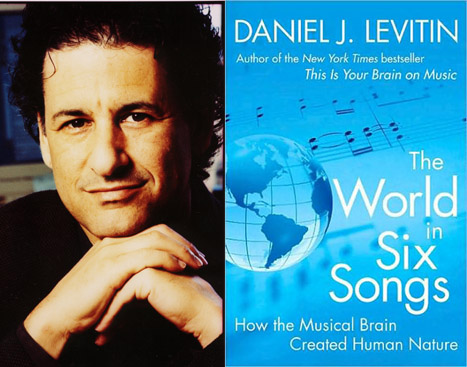
Daniel J. Levitin wrote an absolutely brilliant book called The World in Six Songs, supported by a great website with the many music samples referenced, among other great related material.
My basic paraphrasing of the concept is this. All the songs in the world could be fit into at least one of six categories providing an evolutionary benefit to humanity, often ultimately tied to our social nature.
The book and website offer far more detailed interpretations, of course, but I will expand on my paraphrasing with each post and the associated topic.
In a series of posts, I will describe each of the six categories in brief, one at a time:
I will describe what the categories are about because they are not as limited in scope as the category names suggest. I will then supply one of my choices and ask all readers to do the same if they so wish. In the seventh post of the series, I will offer the chance to put the song choices all together so readers can read the entire set on one post. I do this because it would be a long post to describe all six categories at once, but to have all the answers in one place might be nice.
.
This post focuses on Songs of Religion
July 30th add-on in italics, from Dan Levitin in a summary article
Religious ceremonies and ritual go hand in hand, with music frequently accompanying a ritual. Music acts as a retrieval mechanism to guide the movements and words of a particular ritual, and ritual can allow people to stop worrying and focus on the task at hand. Music is also tied to religious ceremonies such as weddings and funerals where acts can be performed as a community, providing social bonding.
Songs of religion are not simply songs about religion. In fact, the songs of knowledge post showed how the Oral Torah was really a song of knowledge, not religion, even if its lyrics were all about religion. Songs of religion are really ritual songs intended to give meaning to something greater than just the subject itself. Furthermore, this meaning is attached to a belief system that establishes some sort of “social” order, both, less and more than us. It is this search for meaning, a self-conscious act of awareness on our part, for our place in this order which truly separates us from the rest of the animal kingdom. However, it is what we embrace in this search, in turn, that has benefited us in evolution.
In our search for something greater that is part of our religious beliefs, we embrace sets of rituals that exist in all religions. Religion gives meaning to these rituals that have little meaning on their own otherwise. Just look at rituals in religions foreign to you and see how you feel about them compared to those in your own. However, those not familiar with your religion would have no different overall reactions to rituals in your religion. Pages 194-195 has a great list of 11 rituals universal to all religions, though, which is an absolutely fascinating read!
Now, the rituals of religion come in two flavours: self-rituals and group rituals. Self-rituals tend to be of the type which promotes survival, like not murdering others or coveting their mates which could cause conflict among us that is not good for survival. Rituals also mean the actions get repeated, which helps survival if all the actions were good for survival. As for religion’s role, religion gives self-ritual self-meaning, like what it could mean for someone in their current and/or afterlife. Religion also monitors external and internal states for danger in guiding rituals to be done at various times throughout life.
Like it does for self-rituals, religion gives group rituals group meaning and monitors internal and external states to the group. This is the more important benefit to evolution when compared to the self. This is because group rituals promote group activities, which not only protect us from ourselves but also from other factors of harm to us, and better than individuals could do alone. Group rituals are essential to religion because one cannot find a place within a greater social order if there were no one or nothing else around oneself to create this social order.
Finally, all rituals, with their meanings given by religion, are intended to reduce ambiguity in life by changing the state of the world into something more exacting. It also lets us move on with our lives with the direction given so we don’t subject ourselves to situations not beneficial to our survival.
At this point, I would like to insert a note to say that while the general big picture descriptions of religion described in the World in Six Songs are beneficial to evolution, when it comes to the main organized religions in human history, I’m not sure I would concur. I think modern organized religions have become so warped from the spirit of religion’s concept I would debate whether it has had net benefit on humanity or net hindrance. Ironically, this has been since we supposedly have become “civilized”. So much wrong has been done in the name of organized religion, or hidden by it, that I really do think we could do better without it. I think we’d be better off if we only embraced religion in its intent rather than its meanings that it often has no business giving. Organized religion is just a pretense to guide us as if those leading it knew what were happening when they have no idea.
Songs associated with rituals mean there is a time and a place for songs of religion, with consequences. Thus, funeral and wedding marches count, but not national anthems or Christmas carols. There are places and times for national anthems, football fight songs and Christmas carols when you could break out in one or the other, and there wouldn’t be much problem. Try the same with funeral or wedding marches, especially the former, and there might well be. Children’s songs where participants move parts of their body selectively also count as songs of religion because of their ritualistic nature. This practice to develop motor coordination through repetition when we are young and learning is also of benefit to us evolutionally. Finally, gospel songs are religious songs, and it was mentioned that Dan Dennett had suggested that atheists should have pro science gospel songs as atheism doesn’t have gospel religious songs — a thought I, both, like and found tremendously amusing.
Audio sample of songs from the Religion chapter in The World in Six Songs can be found on the website. No direct link was available, but click on the Songs menu option and appropriate page number range link carrying pages 189 to 228. Please note that not all songs are meant as samples of Religion songs. Some are just referenced material in the book text.
Overall, I found this chapter on songs of religion to be very profound and deep, as it should be considering the subject matter. Despite the long post, I have only touched upon the many things Daniel Levitin touched upon for which there is much to think about each.
.
Author Daniel Levitin chose
.
My choice for Song of Religion is
Lacrymosa, by Wolfgang Amadeus Mozart from his incomplete Requiem (funeral music), K. 626, that is magnificent from beginning to end.
It seems the current opinion is that only the first 8 bars were actually written by Mozart, with the rest under instruction for completion. However, listening to it, sounds like the instructions were pretty complete to me.
I have had the pleasure to sing this piece in choir and, well, let’s just say when you hear this piece with all the parts around you, singing one part, that’s when you really “get” the genius of Mozart.
I have also heard this version sung whereby the choir stopped at where it was thought Mozart stopped composing (I believed that version was about 8 bars into the vocal section), and they just stopped dead and walked off. It was so moving, the reminder that Fate doesn’t care for what we do and stops where it wants, that I cried in realizing the finality of it all.
Andrew Lloyd Webber’s Pie Jesu from his Requiem is also a favourite of mine. I have also sung this in choir. Sissel Kyrkjebø does a beautiful job here!
.
I don’t know what to say about all the funeral music selections here. I LOVE classical funeral music for some reason. It gives me such peace and lets me focus incredibly well. I especially like writing anything I need to focus and be concise on to it. Obviously, I don’t blog to it.
.
What is your choice for Song of Religion?
Please leave your choice as a comment.
Lyrics and YouTube/audio link would greatly enhance your answer so readers can know more about your choice. They are not necessary, though, and not possible if no lyrics or version exist.


 In a series of posts, I will describe each of the six categories in brief, one at a time:
 Digital Citizen