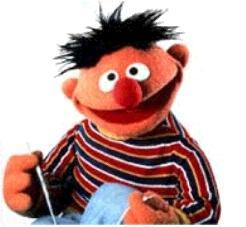
I came across this song at the end of May 2010 via one of those YouTube recommendation feature (enough to blog about it). The feature where because you watched something, its algorithms think you might like something else. Every now and then, it’s good, but this was something I really liked. I just think it’s a cute song, that’s all… and I don’t even have kids. OK, maybe I was influenced by the fact it was Ernie singing it since Ernie has always been my favourite Sesame Street character. But I like the song a lot, nevertheless, and I think lots of people will, too.
I thought when I first heard that song that it’d be a great lullaby for kids, but if you play the guitar or ukulele, you can now pull it out to accompany yourself with that lullaby. Or just sing it for fun like I do.
Ernie, from Sesame Street
The hardest thing about this song is the syncopation. The breaks in the lines are a little bit awkward in places. That’s why all the dashes and commas in the tabs. If those breaks don’t feel natural, then just take a little time to learn them and try not to think about them afterwards when you play. Trust your instincts after you’ve learned where the little breaks are in the lines.
These tabs all fit on one page to avoid the inconvenience of page turns. However, the letter size tabs (8.5″ x 11″) may be too small for your eyes. If so, you can either enlarge to tabloid size (11″ x 17″) using an automatic enlarge feature on many photocopiers, or download the tabloid sized versions for printing. The tabloid size tabs can be inserted into a typical letter sized binder on the 11″ size, and folded almost in half to fit. You just open each tab to use it.
Another challenge to this song is that there are lots of up stroke chord changes, denoted by the / in the tabs. Read left to right, the line goes up like your strumming motion does. If you’re not used to this, it’s not hard to pick it up. Try it and then try not to think about it is how I’d advise you learn. Just go with the flow.
I hope you, your kids, or someone else’s kids (good for entertaining), like this song!
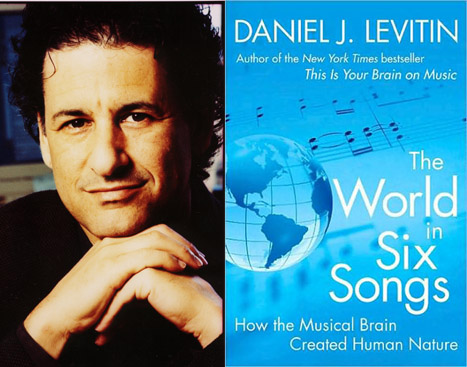
Daniel J. Levitin wrote an absolutely brilliant book called The World in Six Songs, supported by a great website with the many music samples referenced, among other great related material.
My basic paraphrasing of the concept is this. All the songs in the world could be fit into at least one of six categories providing an evolutionary benefit to humanity, often ultimately tied to our social nature.
The book and website offer far more detailed interpretations, of course, but I will expand on my paraphrasing with each post and the associated topic.
In a series of posts, I will describe each of the six categories in brief, one at a time:
I will describe what the categories are about because they are not as limited in scope as the category names suggest. I will then supply one of my choices and ask all readers to do the same if they so wish. In the seventh post of the series, I will offer the chance to put the song choices all together so readers can read the entire set on one post. I do this because it would be a long post to describe all six categories at once, but to have all the answers in one place might be nice.
.
This post focuses on Songs of Joy
July 30th add-on in italics, from Dan Levitin in a summary article
Joy songs are associated with celebration, moments that inspire people to sing, jump, dance and shout. It has been shown that singing releases oxytocin (the hormone released during orgasm), and music listening releases serotonin (a mood-regulating neurotransmitter commonly used in antidepressants). The positive effect of singing or listening to music has also been found to have a positive effect on the immune system, which creates an evolutionary advantage.
These songs celebrate something and reward us for actions that benefit our survival so we would do it again to further improved the odds. “Rewards” are in terms of brain chemicals like oxytocin and serotonin, we naturally release when we feel happy or having performed acts which make us happy. Rewards could also come in reductions of chemicals which do not make us happy, like cortisol and prolactin, which may lead to actions the reduce our chances of survival like violence, reduced physical growth, depression, etc. Additional action of celebration benefits us in a wide range of ways, from the seemingly trivial to the more internal and less visible, like:
Dancing, stretching, jumping or other natural movements to music which are good for our physical well-being;
True emotions, which arise out of benefiting our survival.
In a fascinating argument which I buy into, Daniel Levitin argues that emotions like jealousy are not “true” emotions. Rather, they are “adaptations” to adversity to minimize harm rather than directly benefiting our survival directly. They do not “reward” us in the sense of making us want to repeat actions over and over to benefit our survival. Daniel didn’t say the latter, stating nature does not build systems which defeats itself. However, in trying to keep things simple, that was my conclusion. No doubt, while there are insecure people jealous of everyone else for any number of reasons, most of us would readily admit we could do without jealousy in our lives if we could.
We possess the reward systems of joy today because those of us who enjoyed music of joy, like any of the other categories, were the ones who survived to successfully pass on the genes that allow us to enjoy such music.
As an additional point, Daniel Levitin did not address funny songs in his book. At least I didn’t find anything obvious. One could easily argue that they fall under songs of Friendship because laughing together promotes stronger relationship. I, for one, totally believe that as a major icebreaker to break cultural barriers, to me, is if you can learn to laugh at yourselves and then at each other. But even more, I believe in that anecdote that laughter is the best medicine, and as a result, laughing is good for survival and evolution. So if songs of Joy rewards us for things we should try to do more and more of, songs that makes us laugh should fall here.
Audio sample of songs from the Joy chapter in The World in Six Songs can be found on the website. No direct link was available, but click on the Songs menu option and appropriate page number range link carrying pages 83 to 110. Please note that not all songs are meant as samples of Joy songs. Some are just referenced material in the book text.
It is a joyful song, for sure, and one that definitely makes me want to get out of my seat and dance. I’m standing over the keyboard dancing right now as I’ve got the YouTube version playing to get the link for it! However, this is by no means a definitive choice for me. I can’t say songs of Joy are among the most prominent songs on my mind. I’ve got tons of them as it makes it easier to become happy that way, but in terms of distinctive favourites, none grabs me enough to say “yeah, that’s the one!”
Now, if you’re talking songs of Joy as in humour, my choice would be Nellie McKay‘s Clonie (partial lyrics). Good songs of humour are rare for me, but this one does the job well. I love a lot of her witty, funny and charming music, which I only discovered recently.
.
What is your choice for Song of Joy?
Please leave it as a comment.
Lyrics and YouTube/audio link would greatly enhance your answer so readers can know more about your choice. They are not necessary, though, and not possible if no lyrics or version exist.
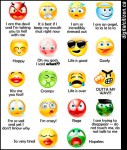
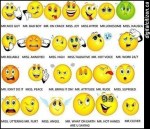
I did not create these emoticon Facebook tagging memes, and I do not know who did to link them to the source. However, I did touch up some of them to optimize them in size for Facebook, and a few I found as graphics searching for pictures that could be used for Facebook tagging. If you like descriptions with your emoticon and smiley memes, try the Emoticons & Smileys without Descriptions post.
To use any of these for your Facebook tagging fun:
Click on the picture to get it at full size.
Right click on that picture and save to your computer.
I did not create these Facebook picture tagging memes, but I improved their quality and optimized their make-up for Facebook usage. I do not know from where they come originally so there is no source link. I only wish they had more resolution to them, being just a bit bigger than the display versions below. Nice idea and plays on words, nonetheless.
To use any of these for your Facebook tagging fun:
Click on the picture to get it at full size.
Right click on that picture and save to your computer.
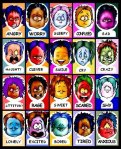
I did not create these three Facebook picture tagging memes, but I either adopted a graphic for Facebook tagging usage (expressions with the lady below), or improved their quality and optimized their make-up for Facebook usage. The ones I improved on, I do not know from where they come so there is no source link.
These memes involve facial expressions. To use any of these for your Facebook tagging fun:
Click on the picture to get it at full size.
Right click on that picture and save to your computer.


 In a series of posts, I will describe each of the six categories in brief, one at a time: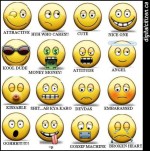


 Digital Citizen