Which Facebook Friends Should I Remove?

Nov 6 2010 update:

This article just became much more relevant after Facebook introduced the Facebook Friendship Page feature on Oct 29, 2010.

Most people on Facebook have far more Facebook Friends than friends they have in real life. It is for social networking, after all, not deep friendships. However, every one of those Facebook friends is watching you, in a way, with Facebook’s notifications and updating system. How many stories have you heard about people caught cheating on relationships, lying for jobs or scholarships, and the like, because of something they did on Facebook that was found out by someone else? Even some misunderstandings of your actions and/or comments can be a lot of nuisance. These public mistakes, visible to all your Facebook Friends, are so common now you might even know someone who has been subject to it! But it’s not that a person did something wrong on Facebook that was the problem. It was that it got picked up by someone else who was probably on their Facebook friends’ list. Privacy settings can’t protect against Facebook friends. Well, they can, but if you have settings against Facebook friends, you should just remove them.

Having a Facebook Friends list closer to your real friends list means you have to worry less about who might get you in trouble. You can also misbehave a little bit more without worrying much about the consequences. Don’t kid yourself if you don’t think there are potential consequences. You’ll also waste less time screening through notifications looking for updates by those you really care about in life.

Keeping your Facebook Friends list up to date is the solution to many of the potential problems previously listed. Keeping your Facebook Friends list up to date means removing people from time to time, not just adding them. It is a judgmental act to remove Facebook friends, but seriously, if you made a wrong call, it’s just Facebook friendships. If you’re real friends to any extent in life, they’ll forgive you and you can be Facebook friends again.

So which Facebook friends should you remove? Well, you choose your own criteria. But here are a few I have found useful… in no particular order, and sometimes in combination as they are not absolute.

Do I feel like removing them or care enough to keep them?

I trust my feelings on this one. If I don’t remove them on gut reaction alone, I sometimes override that with other “thinking” criteria below.

Do I know who they are right away?

Some people’s Facebook Friends lists are so large they can really answer “no” to this question for some on their list. “Facebook whales”, or people with over 1000 Facebook friends, may find this criteria interesting to try. If I can’t remember someone on my Facebook Friends list to the extent I know them right away, I chuck them.

Would they remember who I am?

Facebook whales are prime candidates to be tossed under this criteria. It only takes knowing a few hundred people’s names for someone to seem like they remember everybody, but they really don’t. This criteria is a little hard for people to answer “no” to, because it makes them seem so unimportant to someone else. I just suck it up, so if I have any doubt a Facebook Friend might know who I am, I toss them.

Can I name 3 specific things about them not recently on their updates?

Knowing who someone is, is not exactly a deep criteria. If I barely know who a person is on my Facebook Friends list, I often remove them unless I know they will probably be a useful contact for me in the future. These are the people I often added because they might be a useful contact to me in the future, in the first place. I’m not very discerning to add Facebook friends, but I am to remove them.

Do I hide their status updates or block them on my privacy settings?

This one isn’t absolute for me, but I have eliminated Facebook friends on it. With some people, they’re real friends with annoying habits I put up with cause we’re friends. What people put up with in any type of relationship is more than what they’d put up with strangers due to the bond of the relationship. So I hide their statuses but keep them as Facebook Friends. However, if I’m not real friends to some extent, and am annoyed by their status updates, I tend to remove them. I can find other ways to contact them if I really need to. Certainly, if I ever considered blocking people to any extent with my privacy settings, I remove them.

Have I had any contact with them “lately” (like maybe a year or more)?

If I haven’t had any contact with a person in over a year, I usually remove them. Contact doesn’t mean they have to initiate the contact, but that they should respond to contact I have with them. Some people are so bad they don’t do that, in which case, no need to keep them. I can still be friends if we only ever communicate in real life, but there’s no need to have them snoop on me. We can become Facebook friends again later if they appear in my life again. Technical problems I can’t understand is a good way to explain what “happened” to our previous Facebook friendships.

Do they update their Facebook profile?

The main reason I use Facebook was to be in touch with the lives of people. If they don’t update, that defeats this purpose. We likely wouldn’t have had much contact, either, in which case, off they go!

Do I have them to avoid awkwardness?

There are times when I add people to avoid awkwardness, like partners of female friends. After a while, if I don’t develop any type of friendship with those partners, I remove them. They’ll have had their “check-in” time to make sure I’m not after their girlfriends or spouse. I also know I’m not doing that so the partner’s “jealousy” becomes his problem, not mine.

Those are the criteria I have so far. I may have more in the future and will add if so. If you have suggestions, please do share.

Other Facebook issue posts on my site:

The Prejudices and Privacy Perils of Facebook Quizzes

How to Get Rid of Your Facebook Past

25 Things For Facebook You Can’t Steal My ID With

25 Things You Gave on Facebook to Help Get Your ID Stolen

Una Guía de Netiqueta Práctica para Facebook


Flesch-Kincaid Grade Reading Level: 7.2
The Food Miles Myth – Eat Local for the Economy, Not the Environment

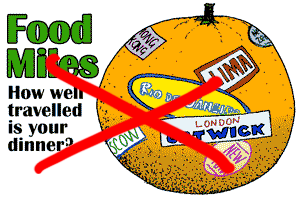
Food miles is a nice concept for awareness, but a meaningless and impractical ideal to believe in for eating local. Eat local for the economy, not the environment. It doesn’t sound as “romantic”, to idealize something for money rather than for the Earth. However, you’re likely idealizing something you wouldn’t be able to prove to be true.

Continue reading

Obama’s Barackets Beating 96.5% of over 4.5 Million Brackets on ESPN 2010 March Madness Challenge After Round 1

President Barack Obama

Please click here to see President Obama’s 2010 Barackets, and get analysis after Round 2

After Round 1 of the 2010 NCAA March Madness Tournament, President Barack Obama’s ESPN Barackets is beating 96.5% of over 4.5 million entries!

See Obama’s 2010 March Madness Brackets here.

See Obama’s rationale in his picks via the ESPN video here.

Obama got 25 of 32 games correct for 250 points since each game in this round was worth 10 points. Three top entries were tied at a remarkable 310 points or 31 of 32 correct! There is no rewards for upsets in the ESPN system so these brackets encouraged going with the favourites rather than picking upsets. That left the President at a rank of 160,151 or sitting in the 96.6th percentile. That means he is ahead of 96.5% of the entries of over 4.5 million entries!

An analogy for that statistic would be the Prez is beating 29 out of every 30 entrants, sitting in 2nd place in such a sample. With over 4.5 million entries, that’s far more than a big enough sample to safely declare the President ahead of 96.5% of all bracket entries out there. He knew his basketball in Round 1, unlike last year when he admitted he got killed in the early rounds.

However, Obama could be in a lot of trouble for the next rounds, each of which is also worth 320 points.

That’s because Obama has already lost one of his Elite Eight teams in Georgetown. That’s 40 points he won’t be getting in that round for sure. I wonder if that were a political pick because Georgetown is, of course, in Washington DC. There weren’t too many Chicago or Illinois teams that stood much of a chance this year to go far.

Obama has also already lost two of his Sweet Sixteen teams with Georgetown and Marquette. That’s another 40 points he won’t be getting in that round.

ESPN lists Obama’s potential points remaining (PPR) at 1,520 after Round 1.

Of course, other people will have likely lost some of those teams already as well. The fact most of them lost more teams this first round only suggest they have a greater chance of losing more teams in the later rounds already than Obama. However, that’s not necessarily true.

My ESPN brackets are sitting at 210 points, or 2,978,307 or ahead of a very lousy 37.6 percent of the entries. Basically, I’m in 6th place out of every 8 people! OUCH! Yet, because I haven’t lost any Elite Eight teams, and the same Georgetown pick as Obama for the Sweet Sixteen, my potential points remaining is 1,580. That could make up the 40 points different the President has on me after Round 1. So despite being over 2.8 million spots back of da Prez right now, I could still end up putting the slamma jamma on Obama!

All that said, the President is doing relatively well among ESPN’s featured brackets.

Obama is first among them after Round 1. In fact, he’s cleaning house… including dunking on LeBron James!

I guess in America, it’s da Prez that rules, not the King. They got rid of him a long time ago! 🙂

You can look at each featured bracket’s potential points remaining if you’d like by clicking on the links above.

How are you doing after the first round if you played? How many games did you get right?

Share/Bookmark

Flesch-Kincaid Grade Reading Level: 5.8

The World in Six Songs Challenge (Part 7 of 7 in series)

Share/Save/Bookmark

.

Book and Theory Background

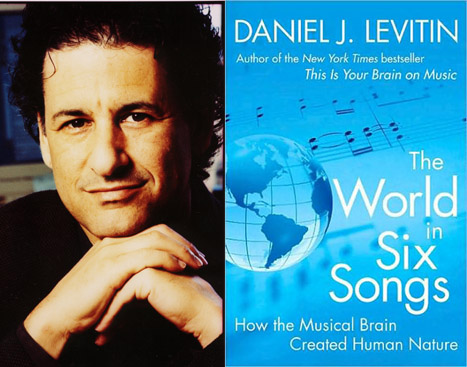
Daniel J. Levitin and The World in Six SongsDaniel J. Levitin wrote an absolutely brilliant book called The World in Six Songs, supported by a great website with the many music samples referenced, among other great related material.

My basic paraphrasing of the concept is this. All the songs in the world could be fit into at least one of six categories providing an evolutionary benefit to humanity, often ultimately tied to our social nature.

I have written about each category individually in separate posts, with song examples, listed below with links if you want to know more. However, here is how author Daniel Levitin has summarized the songs:

  1. Friendship
    Friendship songs centre around group cohesion, whether it be for war, or the bonding of different cliques in high school. For example, in prehistoric warfare, attackers would sometimes ambush another tribe using loud instruments (especially drums) to surprise the targets while they were still sleeping. Countertactics employing the use of singing may also have been used as a signal that the group was awake.  These songs serve to protect a tribe/group or succeed in the takeover of another. In the context of social groups, they provide a sense of community and belonging, bringing people together.
    .
  2. Joy
    Joy songs are associated with celebration, moments that inspire people to sing, jump, dance and shout. It has been shown that singing releases oxytocin (the hormone released during orgasm), and music listening releases serotonin (a mood-regulating neurotransmitter commonly used in antidepressants). The positive effect of singing or listening to music has also been found to have a positive effect on the immune system, which creates an evolutionary advantage.
    .
  3. Comfort
    This category of song provides comfort in times of loneliness, stress or heartbreak, along with the classic comfort song, the lullaby. Music written about loneliness and stress can provide us with comfort by assuring us we are  not alone in our grief or misery, aiding the recovery process. Lullabies mutually calm mother and child, and may release prolactin, while at the same time providing a bond between the two, which is beneficial for the child.
    .
  4. Knowledge
    Historically, songs have been used to transmit various information such as religious texts, survival and life lessons, and even the ABCs. Studies have shown information set to song is memorized more reliably than when simple rote memory is used. Increasing the reliability of transmitted information provides the next generation with valuable information.
    .
  5. Religion
    Religious ceremonies and ritual go hand in hand, with music frequently accompanying a ritual. Music acts as a retrieval mechanism to guide the movements and words of a particular ritual, and ritual can allow people to stop worrying and focus on the task at hand. Music is also tied to religious ceremonies such as weddings and funerals where acts can be performed as a community, providing social bonding.
    .
  6. Love
    Love songs serve as an expression of emotion, commitment, and honesty. They play a role in mating and bonding. Love provides an evolutionary advantage because it is altruistic, and corresponds with commitment, which leads to better care of children, which is an obvious fitness advantage. With altruism, the greater good comes before the individual, strengthening infrastructure.

.

The Challenge: Name or Write Six Songs for the World

.
If you are not a songwriter, your challenge is to name one song you can think of for as many categories as you can.

  • Please leave your answers as a comment if you so choose. Of course, you could always become a songwriter and take the other version below.

.
If you are a songwriter, your challenge is to write at least one song for each category in your career, because songs in some categories are not that easy to write if they serve the purposes required of songs in that category.
I highly recommend you read either my posts or the book for more details on each type of song before writing some songs for each category because song classifications can be misleading to someone briefly familiar with the theory. For example, the Oral Torah that is all about the sacred text of Judaism is a song of knowledge, not religion, because it preserved knowledge, not associated with rituals.

  • If you have written songs, you will have songs which you can populate into some categories already. If you have them online, you are more than welcomed to leave a link in the Comments to share. Please identify the song and the category because most people have their recordings online in bunches, with with MySpace, where there are many songs per web page link. As you write others, you can add new comments until you get your six songs for the world.
  • Or just leave a comment with your name, website or whatever, to indicate you are committing to it.

I AM !!!

.

Flesch-Kincaid Grade Reading Level: 11.7