This is a new type of Facebook tagging, and one that could get you in a lot of trouble, too! 🙂
It’s not because this Facebook tagging is “inappropriate” with language, images or topic. No. It’s because this is going to bruise some egos!
It’s meant for judgmental people so if that’s you, and you’re not afraid to bruise some egos, then go for it! The trade off is that you’ll also praise some people, like giving them an award, so you can also win some favours!
In this Facebook tagging, you have to decide who are your 10 most athletic Facebook friends and tag them.
Those 10 are going to be happy. Those who felt they could have been in the top 10 based on who they saw you tag, cause they thought they were more athletic than at least one of those tagged, won’t! Depending on their personalities, they’ll react in a variety of ways, some of which won’t be pleasant.
Do you think you can handle that? If so, then let’s get on with it!
Like a tens of millions of people around the world, I am watching the final phases leading to the rescue capsule attempt to extract the first of 33 Chilean miners trapped for 68 days now. I really am, blogging during commercials.
There always seems to be “big” breaking news these days, especially on all news network like CNN or CBC Newsworld in Canada. However, every once in a while, something really big comes along, and it is really something to see and feel the world focused on an event like this. I know people watching. I see updates on my Facebook page. I can see people watching walking around in public areas with television screens. Even some sports bars have this drama instead of sports because, in all honesty, it’s far more drama than any sport can provide.
Speaking of television, I wonder what the event will do to the television ratings of shows tonight? And who’s going to be saying I was watching (fill in a Tuesday night show) instead of this at the water cooler at work on Wednesday? What are people going to think of them?
I’m not one to be glued to the television, and definitely not a news junkie, but I can’t remember being this captivated by news since 9/11, and then the start of the Iraq War before that in the 1990s. Very fortunately, this has a much more hopeful and inspirational tone.
But let’s not forget, things could still go wrong. They talk about the potential technical problems. They talk about the potential problems with the physical and mental health of the men as they will take this journey up the shaft back into the world, and the journey back into the social world as everything would have changed in their lives. Not just by the event but family dynamics that made due without them. Roles will have been changed and may forever be changed. Some will use the mine ordeal as excuses to warrant deserving any number of things in their relationships, which will only be tolerated for some time. Certainly, potential career changes will have to be contemplated as going back down into a mine for the next shift won’t be so easy. There will be the media and social circus that some won’t handle well, whether from stress or new opportunities for which they will abandon their old families and/or livelihood given the temptations of fame, and maybe money that comes with it as far as interviews, book and/or movie deals, etc. So much to adapt to and handle that I wonder if 5 or 10 years from now, some of the miners might say the time after the ordeal was more difficult for them to handle than the ordeal itself of being trapped for all that time. Most people can’t handle fame, you know… even the ones who have been living in it for a long time.
Despite all the things anticipated, I can’t help wonder if there might be any potential drama back in the mine when the time comes to get the men out one by one. There’s been a list drawn up, but what if someone decides to buck that at the last moment? It might be out of panic not to have to wait so long, or maybe for some other reasons. There will be rescuers sent down who could be taken hostage, and so on. Humans are a little unpredictable in that sense.
And they will have to repeat this journey 33 miners times so there are plenty of opportunities for things to go wrong.
And what then when something goes wrong? Will they cut off the coverage?
Well, I’ll try not to think about it. Let’s not anyone think about it.
Positive thinking from here on in for everyone’s safety. It might take 2-3 days in total for everyone to get out so after the euphoria of the first rescue, there will still be lots of anticipation and one more spike when the last person comes up.
In the meanwhile, I’ll go and pray. I’m not religious, but I’m not against praying to all the deities out there, either. Let’s just say I believe in praying.
Best wishes to the Chilean miners for a safe return to the surface and to a more regular life. The world is with you.
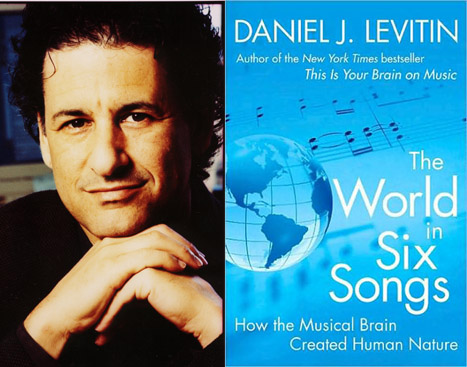
Daniel J. Levitin wrote an absolutely brilliant book called The World in Six Songs, supported by a great website with the many music samples referenced, among other great related material.
My basic paraphrasing of the concept is this. All the songs in the world could be fit into at least one of six categories providing an evolutionary benefit to humanity, often ultimately tied to our social nature.
I have written about each category individually in separate posts, with song examples, listed below with links if you want to know more. However, here is how author Daniel Levitin has summarized the songs:
Friendship
Friendship songs centre around group cohesion, whether it be for war, or the bonding of different cliques in high school. For example, in prehistoric warfare, attackers would sometimes ambush another tribe using loud instruments (especially drums) to surprise the targets while they were still sleeping. Countertactics employing the use of singing may also have been used as a signal that the group was awake. These songs serve to protect a tribe/group or succeed in the takeover of another. In the context of social groups, they provide a sense of community and belonging, bringing people together. .
Joy
Joy songs are associated with celebration, moments that inspire people to sing, jump, dance and shout. It has been shown that singing releases oxytocin (the hormone released during orgasm), and music listening releases serotonin (a mood-regulating neurotransmitter commonly used in antidepressants). The positive effect of singing or listening to music has also been found to have a positive effect on the immune system, which creates an evolutionary advantage. .
Comfort
This category of song provides comfort in times of loneliness, stress or heartbreak, along with the classic comfort song, the lullaby. Music written about loneliness and stress can provide us with comfort by assuring us we are not alone in our grief or misery, aiding the recovery process. Lullabies mutually calm mother and child, and may release prolactin, while at the same time providing a bond between the two, which is beneficial for the child. .
Knowledge
Historically, songs have been used to transmit various information such as religious texts, survival and life lessons, and even the ABCs. Studies have shown information set to song is memorized more reliably than when simple rote memory is used. Increasing the reliability of transmitted information provides the next generation with valuable information. .
Religion
Religious ceremonies and ritual go hand in hand, with music frequently accompanying a ritual. Music acts as a retrieval mechanism to guide the movements and words of a particular ritual, and ritual can allow people to stop worrying and focus on the task at hand. Music is also tied to religious ceremonies such as weddings and funerals where acts can be performed as a community, providing social bonding. .
Love
Love songs serve as an expression of emotion, commitment, and honesty. They play a role in mating and bonding. Love provides an evolutionary advantage because it is altruistic, and corresponds with commitment, which leads to better care of children, which is an obvious fitness advantage. With altruism, the greater good comes before the individual, strengthening infrastructure.
.
The Challenge: Name or Write Six Songs for the World
.
If you are not a songwriter, your challenge is to name one song you can think of for as many categories as you can.
Please leave your answers as a comment if you so choose. Of course, you could always become a songwriter and take the other version below.
.
If you are a songwriter, your challenge is to write at least one song for each category in your career, because songs in some categories are not that easy to write if they serve the purposes required of songs in that category. I highly recommend you read either my posts or the book for more details on each type of song before writing some songs for each category because song classifications can be misleading to someone briefly familiar with the theory. For example, the Oral Torah that is all about the sacred text of Judaism is a song of knowledge, not religion, because it preserved knowledge, not associated with rituals.
If you have written songs, you will have songs which you can populate into some categories already. If you have them online, you are more than welcomed to leave a link in the Comments to share. Please identify the song and the category because most people have their recordings online in bunches, with with MySpace, where there are many songs per web page link. As you write others, you can add new comments until you get your six songs for the world.
Or just leave a comment with your name, website or whatever, to indicate you are committing to it.
Daniel J. Levitin wrote an absolutely brilliant book called The World in Six Songs, supported by a great website with the many music samples referenced, among other great related material.
My basic paraphrasing of the concept is this. All the songs in the world could be fit into at least one of six categories providing an evolutionary benefit to humanity, often ultimately tied to our social nature.
The book and website offer far more detailed interpretations, of course, but I will expand on my paraphrasing with each post and the associated topic.
In a series of posts, I will describe each of the six categories in brief, one at a time:
I will describe what the categories are about because they are not as limited in scope as the category names suggest. I will then supply one of my choices and ask all readers to do the same if they so wish. In the seventh post of the series, I will offer the chance to put the song choices all together so readers can read the entire set on one post. I do this because it would be a long post to describe all six categories at once, but to have all the answers in one place might be nice.
.
This post focuses on Songs of Love
July 30th add-on in italics, from Dan Levitin in a summary article
Love songs serve as an expression of emotion, commitment, and honesty. They play a role in mating and bonding. Love provides an evolutionary advantage because it is altruistic, and corresponds with commitment, which leads to better care of children, which is an obvious fitness advantage. With altruism, the greater good comes before the individual, strengthening infrastructure.
Some may question whether there would be much to say in this chapter because intuitively, I don’t think anybody would say they couldn’t name a “love song”. But that’s a love song in their definition, or a romantic love song, not a song of love as Daniel defined it, backed up by some very prominent names. Indeed, the chapter opens with a quote by Frank Zappa that says “Romantic love songs are a sham that perpetuate a lie on unsuspecting young kids”.
Somehow, I don’t think it stops at young kids.
Frank further follows up with “I think one of the causes of bad mental health in the United States is that people have been raised on ‘love lyrics’.”
Polar opposite Joni Mitchell then jumps in to agree with “There’s no such thing as romantic love. It was a myth invented in ancient Sumeria, repopularized in the Middle Ages, and one that is clearly not true. Romantic love is all about ‘I’ this and ‘I’ that. But true love is about ‘other’.”
And if I were anybody, I’d have jumped in to agree, but I’ll just have to agree on my blog. Songs of love by Daniel Levitin’s theory, and in the purest sense of the word, are about intense feelings for another of any kind. That could be parental, friends, god (no caps on purpose), country, idea, etc. It is about something external and bigger than the self, and bigger than even we, never mind just me, like so many love songs are often about. And it is this something bigger and external to the self, the ideals we have in many aspects of life that develops pillars in our lives and society, that help create the social structure necessary for society and raising children (along the same belief that it takes a village to raise a child).
A note should be added here to clarify that while religion is also about something bigger and external to the self, it is about a search for meaning. Love songs are about the motivation and the doing, without that greater meaning of placement, using the something greater towards creating a favourable social architecture for increasing our chances of survival and evolution.
As for how romantic love songs fits into all of this, they are just a smidgeon of songs of love, and likewise, romantic love of love in the greater sense. The world is full of bad love songs, then, if you think of romantic love songs as representatives of the love song category, for the most part. They are still important, but think of it as strength in numbers rather than true strength within for the few. Many romantic love songs are just for the here and now, to get us there and hold us a bit until either another one comes along or something else comes along to help us. I don’t mean their popularity on the charts, but rather their relevance to us for a moment. They are also an “honest” signal harder to fake than language because it’s harder to hide an emotion via a song than in speaking a phrase. By the way, keep in mind we have only had recording devices to use songs the way we do today in about 0.0001% of our evolutionary history, so the honest signal theory that we sang the songs ourselves to communicate, comparing to speech to say something, applies well to our history. Most of our ancestors could not request or play a song for someone like we can today.
To defend his point that romantic love is just a tiny part of love in the bigger sense, Daniel Levitin presented a very compelling physiological and neurological argument of how romantic love is just a chemical high. In contrast, the idea of love being about the “other” and not the self, is what truly drives us to raise our children, who take far longer and far more resources to develop into a self-sustaining adult than any other babies in the animal kingdom. Romantic love songs only use the “conveyance” component of language, the easy one to get to the here and now, not the computational component that is much longer term. Romantic love songs are about the moment, not the long-term future.
Love, in the real sense of the word that is about the “other” and not the self, is easily just as deep as religion, and the chapter shows it with a lot of deep material touching everything from the psychological, physiological, neurological, philosophical, evolutionary and other aspects of love. It is not challenging to read for reading level required, but the ideas will take time to think about and absorb if you read it seriously. Religion only seems deeper because of its theoretical boundlessness, and because simple romantic love songs have made love seem so trivial. However, I don’t think anybody would disagree that love is what ultimately binds us all together most, and to that end, the Beatles may well have been right that all you need is love. Well, maybe not all as life might still be difficult if that was all you had, but for sure, love is the most imporant thing we need.
Audio sample of songs from the Love chapter in The World in Six Songs can be found on the website. No direct link was available, but click on the Songs menu option and appropriate page number range link carrying pages 229 to 289. Please note that not all songs are meant as samples of Love songs. Some are just referenced material in the book text.
.
Author Daniel Levitin chose
Bring ‘Em All In, by the Waterboys, not just as an example of a love song suitable to his theory, but also as the ultimate love song to fit the example (lyrics).
.
My choice for Song of Love is
We are the World, written by Michael Jackson and performed by a collective of artists (listed with lyrics).
Of the many songs I love as love songs, all are of the romantic love song nature that is but a petty part of the songs of love defined by Daniel Levitin in his World in Six Songs theory. It is really tough to think of a song that unites us all in a caring cause, for the future as much as now. However, I think this one does pretty well, talking about the world, the children, in a call to action (now) for a brighter day (future). I am just very saddened listening to it to see how far Michael Jackson has fallen from a pop star with the often cited Greatest Album of All Time in Thriller (MTV, even in Apr 2009), to someone who could write a song as this, to what he is now.
.
What is your choice for Song of Love?
Please leave your choice as a comment.
Lyrics and YouTube/audio link would greatly enhance your answer so readers can know more about your choice. They are not necessary, though, and not possible if no lyrics or version exist.


 Digital Citizen