It is a simple song to learn or teach for chords and catchy tune. Not a lot of vocal range or skills required. One true verse with a few interchangeable parts. Very meaningful lyrics with a lot of symbolism to say more than just words can say. Very vivid imagery. Tells a story based on a simple concept and closes it all off. Works great with just the singing, one instrument, without drums, or any number of instruments, and in pretty much any style you’d like to perform it. Sounds even better performed in a group. I’m not sure what else you’d want in a song.
My tabbed version is closest to the version by the Kingston Trio in the video below (minus all the picking as I try to keep things simple).
Pete Seeger
Otherwise, I’d have posted a version sung by Pete Seeger himself like this one
This one by Peter, Paul and Mary, with instructions to the audience as they sing it is nice, too.
I hope you will give the song a try if you haven’t already played it.
These tabs all fit on one page to avoid the inconvenience of page turns. However, the letter size tabs (8.5″ x 11″) may be too small for your eyes. If so, you can either enlarge to tabloid size (11″ x 17″) using an automatic enlarge feature on many photocopiers, or download the tabloid sized versions for printing. The tabloid size tabs can be inserted into a typical letter sized binder on the 11″ size, and folded almost in half to fit. You just open each tab to use it.
What were your favourite pieces of music that you heard for the first time last year?
I don’t necessarily mean music that came out last year, just that you heard it for the first time last year because it was new to you. If you care to share, you can put it in the comments following the post. I’d love to know to expand my musical horizons.
Below are a list of favourite songs I heard for the first time in 2009, enough that would fit on CD were I to have made one. Most were from musicals as I really got into them in 2009 after my classic jazz year in 2008. A few were one-off takes on television events, though, so I’ll start with one that was both. It was available on YouTube like most of my selections so I have included the videos to have the music right here for you. I also linked the songs to blog posts I did inspired by them, where I did one.
Someone Like You
from Jekyll & Hyde Linda Eder & Frank Wildhorn on 2000 PBS Special
Linda Eder delivers a loving performance of this gorgeous song with touching lyrics, accompanied by husband Frank Wildhorn, who had composed the song. (blog post)
Vodpod videos no longer available.
Upload of this video sometimes seems a bit slow so please be patient.
If You Were Gay
from Avenue Q
Rick Lyon and John Tartaglia Love and humour, not just in song but also video spoof. (blog post)
The Internet is for Porn
from Avenue Q Stephanie D’Abruzzo, Rick Lyon & the Guys
Possibly the funniest song I have ever heard! (blog post)
Mix Tape
from Avenue Q
Stephanie D’Abruzzo and John Tartaglia
A song that dragged my emotions up and down, enhanced by Stephanie’s nuances of acting while singing this song. (blog post)
As Long as You’re Mine
from Wicked Idina Menzel and Norbert Leo Butz
An often overlooked song from Wicked that I only heard once I saw the musical, rather than hearing the more popular songs from it. However, I loved it immediately, especially the soft-spoken ending.
Academy Awards 2009 Introduction
Hugh Jackman and Anne Hathaway
This number was both brilliant and unexpected in being clever, funny and spectacularly performed. My intro to the full talents of Hugh Jackman. (blog post)
Vodpod videos no longer available.
Monologue Song
from Saturday Night Live November 7, 2009 Taylor Swift
How to trash everybody you want to with class and humour while being really cute about it. (blog post)
Vodpod videos no longer available.
Dark Eyes
by Bob Dylan Judy Collins
Judy Collins gives this sad Dylan song a haunting rendition. (blog post)
Better Angels
Lesley Gore
The original It’s My Party girl seriously grows up with this beautiful tune I first heard on CSI Miami (compilation video of episode shown below).
I Got a Feeling
Black Eyed Peas
Just an awesome dance song, ’nuff said cause I’m getting dancing! Best 2009 song in my opinion. (I chose the flash mob version shown on Oprah for the video cause it’s also so awesome!)
Wake-up
The Arcade Fire
I heard this song via the trailer for Where the Wild Things Are and thought they had made a pretty good choice for a theme song.
The Closest Thing to Crazy
by Mike Batt Katie Melua
Pretty much describes what feeling in love feels like to me. (blog post)
I Want a Hippopotamus for Christmas
Gayla Peevey
I heard it on a Telus commercial and loved it immediately, a bit surprised I had never heard this 1950s seasonal classic until now. (blog post)
You’ve Gotta Have a Gimmick
from There’s No Business Like Show Business Bernadette Peters, Julia McKenzie, Ruthie Henshall
This is probably the ultimate example of my claim that girls have all the fun songs in musicals, and the video only emphasizes the point.
Married
from Cabaret Ron Rifkin, Michelle Pawk A charming little song about marriage. A compact version is shown below.
Mystery
performed on the show Inside the Actor’s Studio Hugh Laurie
A hilarious and charming example of how lyric writing sometimes feels like to me, trying to find desperate rhymes and more desperate words that conform with desperate rhymes. (blog post)
Love, Look in my Window
from Hello Dolly!
Ethel Merman
There isn’t a video for this one but the piece was written for Ethel Merman when she joined Hello Dolly! If you hear her perform it with the emotions she does, you’ll know why it was written for her. I can hardly keep from crying at points in it. Probably good I don’t have the music for that reason!
This is my own song, uploaded for the purposes of testing out the SoundCloud music player features newly integrated into WordPress.com blogs. Please do have a listen while reading some general descriptions of the SoundCloud platform following to see those features in action. I wrote the song, but it was beautifully sung by Lis Soderberg, with background parts, recording and mixing all done by the very talented Allister Bradley in the summer of 2008 at Humber College. I just strummed on a guitar. Lyrics are at the bottom. 🙂
Up till Aug 2009, there wasn’t a music player, and not one with social media features, on WordPress.com blogs. If you wanted to share audio files with such features, your best bet was probably to make a “static video”. You know, those “videos” with just one image and sound? Either that or get a space upgrade to be able to upload MP3 files, but there wasn’t a real music player with it
Well, I’m so happy to see WordPress.com finally has a system to integrate sound media files into its blogs the way video was been integrated for a while! They chose SoundCloud.com as their platform, the way they had chosen VodPod for videos.
“[SoundCloud is] …a really useful service that is part Flickr for music, part professional music collaboration hub. Artists such as Beck, Moby and Sonic Youth now use the service to distribute tracks through their blogs and connect with their fans.”
— WordPress.com blog, Aug 13 2009
More than just another free music player, though, SoundCloud has some quite awesome features.
You can leave comments at specific points in the track so you don’t have to go find the time, or try to describe it awkwardly, etc.
You can just click a share button to share it on Facebook and various other social media or social bookmarking sites! That’s very nice!
The sharing of music otherwise among members is similar to the combination of notification on Facebook, and Inbox notifications, on your account via SoundCloud’s side. You can “follow” people like on Twitter to get the info via newsfeed, or get notice similar to a tag or email sent to you and/or your email off the site.
There is even code provided for people to embed it into their blogs and websites, with the player included! That’s really cool!
Their music player is like “fab five” man! You can also control lots of privacy features, and you get your own URL for your account on their site that the public may also visit like how MySpace works.
A free account can be had with 10 tracks for sharing, an Inbox, detailed statistics, viewing, privacy and other features of popular music and video sites at least as good as most of those other sites.
The WordPress folks really picked a fantastic platform in SoundCloud! Well done!
Of course, you should not be uploading copyrighted material that isn’t yours to SoundCloud. That was to be expected. But how nice, was it then, that I just happened to have a song I had written and recorded in the past to use? I don’t devote enough time to my singing/songwriting, and I don’t exactly go pimping my music a lot, even to many of my friends. So here’s hoping there’s something new here for some of them, and you, to enjoy, aside from the tech review.
I will be further checking out SoundCloud’s features in the upcoming weeks and months. It’s given me a whole new set of motivation to write more songs and record more. In the meanwhile, if you want to know more, you can take the tour on their site.
I would highly recommend it!
LYRICS
I could compare you to a summer’s day,
Or, if you prefer, a winter’s night.
I could compare you to the moon unphased,
Or the sun at dawn, noon or in twilight.
All lovely things I can compare you to,
But there’s not one that can compare to you.
I could compare you to the sweetest tune,
Or, if you prefer, the sweetest kiss.
I could compare you to a sacred rune,
Or the lores, that tell of eternal bliss.
All lovely things I can compare you to,
But there’s not one that can compare to you.
Choose any flower that blooms in the spring,
Or any leaf that turns in the fall.
Choose stars, or rainbows, angels, songs birds sing,
Or the sky, or sea – any thing at all!
All lovely things I can compare you to,
But there’s not one that can compare to you.
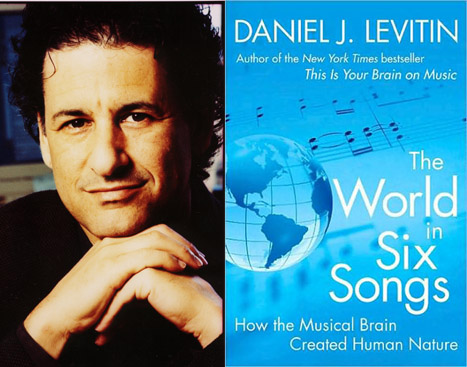
Daniel J. Levitin wrote an absolutely brilliant book called The World in Six Songs, supported by a great website with the many music samples referenced, among other great related material.
My basic paraphrasing of the concept is this. All the songs in the world could be fit into at least one of six categories providing an evolutionary benefit to humanity, often ultimately tied to our social nature.
I have written about each category individually in separate posts, with song examples, listed below with links if you want to know more. However, here is how author Daniel Levitin has summarized the songs:
Friendship
Friendship songs centre around group cohesion, whether it be for war, or the bonding of different cliques in high school. For example, in prehistoric warfare, attackers would sometimes ambush another tribe using loud instruments (especially drums) to surprise the targets while they were still sleeping. Countertactics employing the use of singing may also have been used as a signal that the group was awake. These songs serve to protect a tribe/group or succeed in the takeover of another. In the context of social groups, they provide a sense of community and belonging, bringing people together. .
Joy
Joy songs are associated with celebration, moments that inspire people to sing, jump, dance and shout. It has been shown that singing releases oxytocin (the hormone released during orgasm), and music listening releases serotonin (a mood-regulating neurotransmitter commonly used in antidepressants). The positive effect of singing or listening to music has also been found to have a positive effect on the immune system, which creates an evolutionary advantage. .
Comfort
This category of song provides comfort in times of loneliness, stress or heartbreak, along with the classic comfort song, the lullaby. Music written about loneliness and stress can provide us with comfort by assuring us we are not alone in our grief or misery, aiding the recovery process. Lullabies mutually calm mother and child, and may release prolactin, while at the same time providing a bond between the two, which is beneficial for the child. .
Knowledge
Historically, songs have been used to transmit various information such as religious texts, survival and life lessons, and even the ABCs. Studies have shown information set to song is memorized more reliably than when simple rote memory is used. Increasing the reliability of transmitted information provides the next generation with valuable information. .
Religion
Religious ceremonies and ritual go hand in hand, with music frequently accompanying a ritual. Music acts as a retrieval mechanism to guide the movements and words of a particular ritual, and ritual can allow people to stop worrying and focus on the task at hand. Music is also tied to religious ceremonies such as weddings and funerals where acts can be performed as a community, providing social bonding. .
Love
Love songs serve as an expression of emotion, commitment, and honesty. They play a role in mating and bonding. Love provides an evolutionary advantage because it is altruistic, and corresponds with commitment, which leads to better care of children, which is an obvious fitness advantage. With altruism, the greater good comes before the individual, strengthening infrastructure.
.
The Challenge: Name or Write Six Songs for the World
.
If you are not a songwriter, your challenge is to name one song you can think of for as many categories as you can.
Please leave your answers as a comment if you so choose. Of course, you could always become a songwriter and take the other version below.
.
If you are a songwriter, your challenge is to write at least one song for each category in your career, because songs in some categories are not that easy to write if they serve the purposes required of songs in that category. I highly recommend you read either my posts or the book for more details on each type of song before writing some songs for each category because song classifications can be misleading to someone briefly familiar with the theory. For example, the Oral Torah that is all about the sacred text of Judaism is a song of knowledge, not religion, because it preserved knowledge, not associated with rituals.
If you have written songs, you will have songs which you can populate into some categories already. If you have them online, you are more than welcomed to leave a link in the Comments to share. Please identify the song and the category because most people have their recordings online in bunches, with with MySpace, where there are many songs per web page link. As you write others, you can add new comments until you get your six songs for the world.
Or just leave a comment with your name, website or whatever, to indicate you are committing to it.
Daniel J. Levitin wrote an absolutely brilliant book called The World in Six Songs, supported by a great website with the many music samples referenced, among other great related material.
My basic paraphrasing of the concept is this. All the songs in the world could be fit into at least one of six categories providing an evolutionary benefit to humanity, often ultimately tied to our social nature.
The book and website offer far more detailed interpretations, of course, but I will expand on my paraphrasing with each post and the associated topic.
In a series of posts, I will describe each of the six categories in brief, one at a time:
I will describe what the categories are about because they are not as limited in scope as the category names suggest. I will then supply one of my choices and ask all readers to do the same if they so wish. In the seventh post of the series, I will offer the chance to put the song choices all together so readers can read the entire set on one post. I do this because it would be a long post to describe all six categories at once, but to have all the answers in one place might be nice.
.
This post focuses on Songs of Love
July 30th add-on in italics, from Dan Levitin in a summary article
Love songs serve as an expression of emotion, commitment, and honesty. They play a role in mating and bonding. Love provides an evolutionary advantage because it is altruistic, and corresponds with commitment, which leads to better care of children, which is an obvious fitness advantage. With altruism, the greater good comes before the individual, strengthening infrastructure.
Some may question whether there would be much to say in this chapter because intuitively, I don’t think anybody would say they couldn’t name a “love song”. But that’s a love song in their definition, or a romantic love song, not a song of love as Daniel defined it, backed up by some very prominent names. Indeed, the chapter opens with a quote by Frank Zappa that says “Romantic love songs are a sham that perpetuate a lie on unsuspecting young kids”.
Somehow, I don’t think it stops at young kids.
Frank further follows up with “I think one of the causes of bad mental health in the United States is that people have been raised on ‘love lyrics’.”
Polar opposite Joni Mitchell then jumps in to agree with “There’s no such thing as romantic love. It was a myth invented in ancient Sumeria, repopularized in the Middle Ages, and one that is clearly not true. Romantic love is all about ‘I’ this and ‘I’ that. But true love is about ‘other’.”
And if I were anybody, I’d have jumped in to agree, but I’ll just have to agree on my blog. Songs of love by Daniel Levitin’s theory, and in the purest sense of the word, are about intense feelings for another of any kind. That could be parental, friends, god (no caps on purpose), country, idea, etc. It is about something external and bigger than the self, and bigger than even we, never mind just me, like so many love songs are often about. And it is this something bigger and external to the self, the ideals we have in many aspects of life that develops pillars in our lives and society, that help create the social structure necessary for society and raising children (along the same belief that it takes a village to raise a child).
A note should be added here to clarify that while religion is also about something bigger and external to the self, it is about a search for meaning. Love songs are about the motivation and the doing, without that greater meaning of placement, using the something greater towards creating a favourable social architecture for increasing our chances of survival and evolution.
As for how romantic love songs fits into all of this, they are just a smidgeon of songs of love, and likewise, romantic love of love in the greater sense. The world is full of bad love songs, then, if you think of romantic love songs as representatives of the love song category, for the most part. They are still important, but think of it as strength in numbers rather than true strength within for the few. Many romantic love songs are just for the here and now, to get us there and hold us a bit until either another one comes along or something else comes along to help us. I don’t mean their popularity on the charts, but rather their relevance to us for a moment. They are also an “honest” signal harder to fake than language because it’s harder to hide an emotion via a song than in speaking a phrase. By the way, keep in mind we have only had recording devices to use songs the way we do today in about 0.0001% of our evolutionary history, so the honest signal theory that we sang the songs ourselves to communicate, comparing to speech to say something, applies well to our history. Most of our ancestors could not request or play a song for someone like we can today.
To defend his point that romantic love is just a tiny part of love in the bigger sense, Daniel Levitin presented a very compelling physiological and neurological argument of how romantic love is just a chemical high. In contrast, the idea of love being about the “other” and not the self, is what truly drives us to raise our children, who take far longer and far more resources to develop into a self-sustaining adult than any other babies in the animal kingdom. Romantic love songs only use the “conveyance” component of language, the easy one to get to the here and now, not the computational component that is much longer term. Romantic love songs are about the moment, not the long-term future.
Love, in the real sense of the word that is about the “other” and not the self, is easily just as deep as religion, and the chapter shows it with a lot of deep material touching everything from the psychological, physiological, neurological, philosophical, evolutionary and other aspects of love. It is not challenging to read for reading level required, but the ideas will take time to think about and absorb if you read it seriously. Religion only seems deeper because of its theoretical boundlessness, and because simple romantic love songs have made love seem so trivial. However, I don’t think anybody would disagree that love is what ultimately binds us all together most, and to that end, the Beatles may well have been right that all you need is love. Well, maybe not all as life might still be difficult if that was all you had, but for sure, love is the most imporant thing we need.
Audio sample of songs from the Love chapter in The World in Six Songs can be found on the website. No direct link was available, but click on the Songs menu option and appropriate page number range link carrying pages 229 to 289. Please note that not all songs are meant as samples of Love songs. Some are just referenced material in the book text.
.
Author Daniel Levitin chose
Bring ‘Em All In, by the Waterboys, not just as an example of a love song suitable to his theory, but also as the ultimate love song to fit the example (lyrics).
.
My choice for Song of Love is
We are the World, written by Michael Jackson and performed by a collective of artists (listed with lyrics).
Of the many songs I love as love songs, all are of the romantic love song nature that is but a petty part of the songs of love defined by Daniel Levitin in his World in Six Songs theory. It is really tough to think of a song that unites us all in a caring cause, for the future as much as now. However, I think this one does pretty well, talking about the world, the children, in a call to action (now) for a brighter day (future). I am just very saddened listening to it to see how far Michael Jackson has fallen from a pop star with the often cited Greatest Album of All Time in Thriller (MTV, even in Apr 2009), to someone who could write a song as this, to what he is now.
.
What is your choice for Song of Love?
Please leave your choice as a comment.
Lyrics and YouTube/audio link would greatly enhance your answer so readers can know more about your choice. They are not necessary, though, and not possible if no lyrics or version exist.



 Digital Citizen