These are targets every person or group trying to instill social change needs to know to gauge the likelihood or their success.
Recent research has shown that for true social change to occur, you’d need 7-10% of a population to hold an unshakable belief to be able to change the belief of that population within a reasonable amount of time. This is as long as there isn’t another group with another unshakable belief opposing it, like a different religion (Discovery News, August 6 2011). Combine that with the 1% you need to start a movement (Microtrends, by Mark Penn) and you’ve got two real targets for any organization seeking to create lasting social change. There’s none of those around these days, are there? 🙂
After Round 1 of the 2011 NCAA March Madness Tournament, President Barack Obama’s safe “presidential style” Barackets is beating 11,336 of about six million brackets, or about 99.8% of them!
I’ve got over 250 cartoon pictures made for Facebook profile pics at the bottom, arranged in alphabetical order with names, which include some modern and some old cartoons.
I’ve recently written some posts on purging your Facebook friends list due to the misuse, abuse and harm of Facebook friendships incurred by many people (links below). The issue has recently gotten more attention via talk show host Jimmy Kimmel calling for Wednesday, November 17, to be National Unfriend Day of NUD, and I am here to help with some tips and challenges should you want to take part in National Unfriend Day. This also goes for MySpace, LiveJournal, Bebo and other social networking platforms where you can add friends, but the main focus is on the largest social networking platform in the world, which is Facebook.
Vodpod videos no longer available.
Why you would want to take part in Unfriend Day (or do it on another day)
Because Facebook friends can be spies, now or in the future when someone decides to no longer like you, especially people you don’t know well but have as Facebook friends. With Facebook’s new Friendship Page feature that gives everyone creepy new spying capabilities on other people’s profiles, the fact that Facebook friends can be spies has never been truer. Facebook friends have access to everything you have unless you block them from specific things. But let’s be serious. How many people really do that? And even if you did, isn’t that enough of a creep factor to get you to unfriend them? And why are you causing yourself stress in watching your back on Facebook all the time since you might have to block certain friends from potentially every new thing you post?
Jimmy Kimmel talks about unfriending because Facebook has cheapened the meaning of friendship. I have also written similarly about the meaning of friendship versus Facebook friendship. However, there is a real life threat to Facebook friendship and not just an ideology here.
If you missed National Unfriend Day, there’s no reason NUD couldn’t be any other day during the year for you. In fact, I would recommend you purge your Facebook friends list several times during the year.
Facebook activities don’t get you in trouble, Facebook friends who see them do
It seems to me we’ve had enough bad stories of people getting caught on Facebook for everything from cheating to hate statements to inappropriate work comment and other such bad behaviours, but not many people still care all that much. Just remember, those behaviours aren’t what got those people in trouble. It’s the fact they had Facebook friends who saw the behaviours and did something about it, even if unintentional like sharing it in some way, online or in real life.
Will people think you mean for dropping Facebook friends?
Hardly. People seem to think that those with tons of meaningless Facebook friends are the ones who are insecure. Knowing who your friends are, and who are not, is a sign of personal security and integrity, not being mean.
What if the unfriended request being friends again?
If you have common friends with someone you untag, they may notice having been removed if you post something on your mutual friend’s wall and they see it by looking or a notification of others posting on the same post. They’ll probably only realize it because they see your name and realize they hadn’t seen any updates from you in a while. So what if they add you again? Awkward?
Maybe. But you can avoid it by blocking them after you remove them. Or ignore the friendship request. If it means that much to them, and if you have any real friendship in life, they can talk to you about it. If you have any real friendship in life, this Facebook friend stuff shouldn’t matter. Really, it’s not the end of the world.
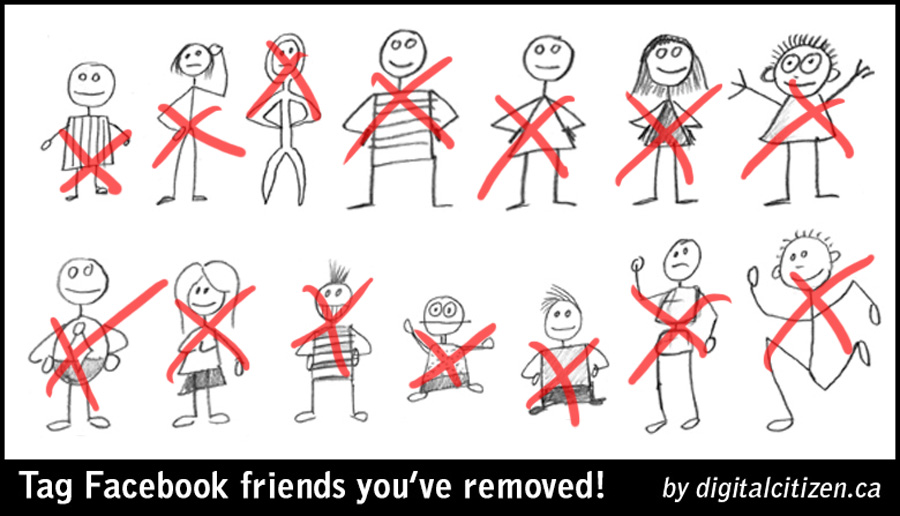
For those who like to flaunt their life fun on Facebook, especially if there’s a little element of risk to it, how’s about flaunting your Facebook unfriending Facebook tagging style?
Facebook friends dumped tagging meme
I highly recommend you do this after you unfriend the people you tag, of course. Now, you can’t tag a picture with a link to someone you aren’t Facebook friends with, but you can always type in their names instead of choosing from a box listing your Facebook friends. This is like if you were to tag a photo of the Loch Ness monster, Darth Vader, Wolverine, Harry Potter, Bella Swan or anything else. They don’t have Facebook profiles, so far as I know, but you can still tag them in pictures. Same idea for Facebook friends you’ve dumped.
Good luck with National Unfriend Day, Jimmy and the world!
I don’t know how much media clout, or pull, Jimmy Kimmel will have in proposing National Unfriend Day, but it’s good advice. Even if it doesn’t do well, it’s the first year. Things take time to adapt, and more time if it’s a once a year occurrence. But remember what I said above…
If you missed National Unfriend Day, there’s no reason NUD couldn’t be any other day during the year for you. In fact, I would recommend you purge your Facebook friends list several times during the year.
Remember this fun Facebook in Real Life video? It needs a seriously creepy update!
Vượt Biên: Voyage of a Diaspora is my silent one minute film that metaphorically depicts the Vietnamese Boat People’s journey for freedom, using photos from the United Nations’ Photo Library, among other sources.
This past spring, I was fortunate enough to have been accepted into the One Minute Film (OMF) program with the Atlantic Filmmakers’ Cooperative (AFCOOP) in Halifax, Nova Scotia. This is a video rendition of my OMF project, not a digitization for reasons described in the Production Notes of the film press kit, so the poor quality. However, this will suffice to share with others who would otherwise literally need a film projector to be able to see it.
The film press kit also has much more detail on the topics covered, images, production notes and additional resources about the Vietnamese Boat People.
The One Minute Film experience was an incredible one for me, and I think I could say the same on behalf of my colleagues in the program. We were trained on everything from story development, which is challenging in a one minute film for all kinds of genres, to lighting, camera operations and techniques like animation, film properties and handling, editing, casting, among many other topics. We had a great diversity of styles and genres, and all the hard work paid off as all the films turned out fabulously! I am the first to post mine online, but as more of my colleagues do, I will add links.
You can search one minute film on YouTube to see a whole host of others as this is a genre and program which exists in many countries and has been done for many years.
The OMF project was my first experience with film, but the mentors, instructors and AFCOOP staff did a fabulous job with me and my colleagues to help us produce what we did. In the age of digital YouTube where people just snap and film everything digitally, impromptu, people pick up a lot of bad artistic habits from never having to think about preparing for shots and just take an infinite number of redos until they get something sort of OK. What I learned through the OMF program will be of value to me in many capacities, not just filming, for a long time to come. The skills are valuable for lots of forms of communication, from writing to film to photography, but the preparation habits will be priceless. The discipline from having to work hard for one take so you would prepare as much as possible to prevent things from going wrong is hard to teach, and harder to undo for the young casual digital shooters who never knew what it’s like to have 24 film shots in a camera with a price to develop each shot.
I would highly recommend the film experience if you have never tried it. Check with local film organizations in your local area to see if they have intro film programs, especially something like the One Minute Film program. In Nova Scotia, the entry forms to the program can be found on the AFCOOP site in January, with the deadlines for February 1 or there abouts. Don’t pass it up if you have ever had any inkling to try out making film, even if ultimately digital. The program is free! Your ideas and work are the only things required, with incredible gratification for what you put in.
Aside from big thanks to my OMF colleagues, AFCOOP staff, mentors and instructors, I would also like to thank my Parents and a certain lady at the United Nations photo library in New York, which is not a public archive. When I showed up at their doorstep and told her my story, she signed me in past security and gave me access to their entire digitized collection of Vietnamese refugee photos. That definitely made it easier for me to make this film with all the photos and not having to decide right on the spot which ones I would request. Serendipity has been with me again and again, in ways I could not believe, in the making of this film, and I am grateful to whomever I should be.

 Digital Citizen