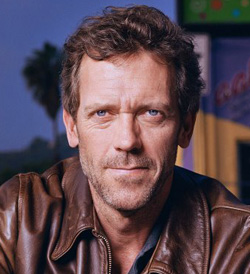
This is Hugh Laurie of( Dr. Gregory) House M.D. fame, singing a comedic song, Mystery, during a June 2006 appearance on Inside the Actor’s Studio. The song was originally from the show A Bit of Fry and Laurie.
I’m not posting this for performance, or lyrics or musicality. Rather, I’m posting it because the way Hugh put a little acting into all the little spots in the song as if he were improvising. At various points, he pretends to struggle to come up with a rhyme, the idea for the next verse, how to manipulate a word to rhyme, making up new words, squeezing in entire phrases, etc.
What all that feels like is the struggle, and mystery, of lyric writing for songwriting. The various methods, successes and failures of “creativity” to find that elusive lyric, sometimes forced and sometimes “enlightened”, are demonstrated well, I thought. The song is simple enough you can just sit and dissect the lyrics, which are included under the video below. The tune and musical chord progressions are nice and simple, too.
Besides that, I’m not sure I can say much about the “mystery” of lyric writing. It just kind of feels this way, if you’ve never experienced it yourself.
If you have, I’d love to hear your descriptions of it. Thanks!
.
Mystery
All my life has been a mystery
You and I were never ever meant to be
That’s why I call my love for you a mystery
Different country
You and I have always lived in a different country
And I know that airline tickets don’t grow on a tree
So what kept us apart is plain (plane?) for me to see
That much at least is not really a mystery
Estuary
I live in a houseboat on an estuary
Which is handy for my work with the Port Authority
But I know you would have found it insanitary
Insanitary
Hated me
I’d be foolish to ignore the possibility
That if we’d ever actually met, you might have really taken a violent dislike to me
Still, that’s not the only problem that I can see
Dead since 1993
You’ve been dead now . . . wait a minute, let me see…
Fourteen years come next Jan-uary
As a human being you are history
So why do I still long for you?
Why is my love so strong for you?
Why did I write this song for you?
Well, I guess it’s just a mystery
I am making my way through the Dylan discography to learn more about his music. I have to go slowly because like Emily Dickinson’s poetry, you can only take so much at a time before you either go numb or it hurts your head too much to take any more given the power of all the meanings contained within it. The beauty of good poetry is that it’s like being able to tell many stories in many languages all at once. The beauty of a song with good lyrics is that it adds one more language, the universal language of music, to the power of poetry.
Not long ago, I came across this hidden gem of a song by Bob Dylan, Dark Eyes. Bob Dylan has written many songs amazing to an extent I don’t have words to describe them, but not all are well known. That’s why I called it a hidden gem.
(Courtesy of Wikipedia)
From the 1985 album Empire Burlesque, Dark Eyes was written virtually on demand when Arthur Baker suggested something simpler for the album’s final track. Dylan liked the idea of closing the album with a stark, acoustic track, particularly when the rest of the album was so heavily produced. However, Dylan didn’t have an appropriate song. He returned to his hotel in Manhattan after midnight, and according to Dylan:
“As I stepped out of the elevator, a call girl was coming toward me in the hallway – pale yellow hair wearing a fox coat – high heeled shoes that could pierce your heart. She had blue circles around her eyes, black eyeliner, dark eyes. She looked like she’d been beaten up and was afraid that she’d get beat up again. In her hand, crimson purple wine in a glass. ‘I’m just dying for a drink,’ she said as she passed me in the hall. She had a beautifulness, but not for this kind of world.”
The brief, chance encounter inspired Dylan to write “Dark Eyes,” which was quickly recorded without any studio embellishment. Structured like a children’s song, with very rudimentary guitar work and very simple notes, it’s often quoted for its last chorus: “A million faces at my feet, but all I see are dark eyes.”
.
As for what I think of Dark Eyes, I would put its lyrics, following the fan video below, on the same level as any other of Dylan’s songs. That’s a general ranking, though, rather than one for purposes like war songs or love songs, etc. I especially like how the “chorus” is just one simple line at the end of the verse, as simple as the musical structure of the song. This version I heard, though, was magnificently performed by Judy Collins who not only had a beautiful voice, but a beautiful one to properly treat this song in performance. Everything all taken into account, Dark Eyes has already become a favourite Dylan song, and Judy’s version a favourite Dylan cover.
.
Oh, the gentlemen are talking and the midnight moon is on the riverside,
They’re drinking up and walking and it is time for me to slide.
I live in another world where life and death are memorized,
Where the earth is strung with lovers’ pearls and all I see are dark eyes.
A cock is crowing far away and another soldier’s deep in prayer,
Some mother’s child has gone astray, she can’t find him anywhere.
But I can hear another drum beating for the dead that rise,
Whom nature’s beast fears as they come and all I see are dark eyes.
They tell me to be discreet for all intended purposes,
They tell me revenge is sweet and from where they stand, I’m sure it is.
But I feel nothing for their game where beauty goes unrecognized,
All I feel is heat and flame and all I see are dark eyes.
Oh, the French girl, she’s in paradise and a drunken man is at the wheel,
Hunger pays a heavy price to the falling gods of speed and steel.
Oh, time is short and the days are sweet and passion rules the arrow that flies,
A million faces at my feet but all I see are dark eyes.
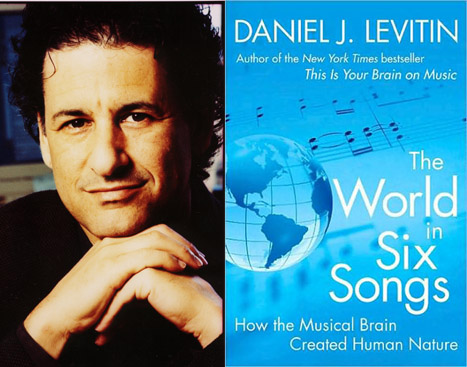
Daniel J. Levitin wrote an absolutely brilliant book called The World in Six Songs, supported by a great website with the many music samples referenced, among other great related material.
My basic paraphrasing of the concept is this. All the songs in the world could be fit into at least one of six categories providing an evolutionary benefit to humanity, often ultimately tied to our social nature.
The book and website offer far more detailed interpretations, of course, but I will expand on my paraphrasing with each post and the associated topic.
In a series of posts, I will describe each of the six categories in brief, one at a time:
I will describe what the categories are about because they are not as limited in scope as the category names suggest. I will then supply one of my choices and ask all readers to do the same if they so wish. In the seventh post of the series, I will offer the chance to put the song choices all together so readers can read the entire set on one post. I do this because it would be a long post to describe all six categories at once, but to have all the answers in one place might be nice.
.
This post focuses on Songs of Religion
July 30th add-on in italics, from Dan Levitin in a summary article
Religious ceremonies and ritual go hand in hand, with music frequently accompanying a ritual. Music acts as a retrieval mechanism to guide the movements and words of a particular ritual, and ritual can allow people to stop worrying and focus on the task at hand. Music is also tied to religious ceremonies such as weddings and funerals where acts can be performed as a community, providing social bonding.
Songs of religion are not simply songs about religion. In fact, the songs of knowledge post showed how the Oral Torah was really a song of knowledge, not religion, even if its lyrics were all about religion. Songs of religion are really ritual songs intended to give meaning to something greater than just the subject itself. Furthermore, this meaning is attached to a belief system that establishes some sort of “social” order, both, less and more than us. It is this search for meaning, a self-conscious act of awareness on our part, for our place in this order which truly separates us from the rest of the animal kingdom. However, it is what we embrace in this search, in turn, that has benefited us in evolution.
In our search for something greater that is part of our religious beliefs, we embrace sets of rituals that exist in all religions. Religion gives meaning to these rituals that have little meaning on their own otherwise. Just look at rituals in religions foreign to you and see how you feel about them compared to those in your own. However, those not familiar with your religion would have no different overall reactions to rituals in your religion. Pages 194-195 has a great list of 11 rituals universal to all religions, though, which is an absolutely fascinating read!
Now, the rituals of religion come in two flavours: self-rituals and group rituals. Self-rituals tend to be of the type which promotes survival, like not murdering others or coveting their mates which could cause conflict among us that is not good for survival. Rituals also mean the actions get repeated, which helps survival if all the actions were good for survival. As for religion’s role, religion gives self-ritual self-meaning, like what it could mean for someone in their current and/or afterlife. Religion also monitors external and internal states for danger in guiding rituals to be done at various times throughout life.
Like it does for self-rituals, religion gives group rituals group meaning and monitors internal and external states to the group. This is the more important benefit to evolution when compared to the self. This is because group rituals promote group activities, which not only protect us from ourselves but also from other factors of harm to us, and better than individuals could do alone. Group rituals are essential to religion because one cannot find a place within a greater social order if there were no one or nothing else around oneself to create this social order.
Finally, all rituals, with their meanings given by religion, are intended to reduce ambiguity in life by changing the state of the world into something more exacting. It also lets us move on with our lives with the direction given so we don’t subject ourselves to situations not beneficial to our survival.
At this point, I would like to insert a note to say that while the general big picture descriptions of religion described in the World in Six Songs are beneficial to evolution, when it comes to the main organized religions in human history, I’m not sure I would concur. I think modern organized religions have become so warped from the spirit of religion’s concept I would debate whether it has had net benefit on humanity or net hindrance. Ironically, this has been since we supposedly have become “civilized”. So much wrong has been done in the name of organized religion, or hidden by it, that I really do think we could do better without it. I think we’d be better off if we only embraced religion in its intent rather than its meanings that it often has no business giving. Organized religion is just a pretense to guide us as if those leading it knew what were happening when they have no idea.
Songs associated with rituals mean there is a time and a place for songs of religion, with consequences. Thus, funeral and wedding marches count, but not national anthems or Christmas carols. There are places and times for national anthems, football fight songs and Christmas carols when you could break out in one or the other, and there wouldn’t be much problem. Try the same with funeral or wedding marches, especially the former, and there might well be. Children’s songs where participants move parts of their body selectively also count as songs of religion because of their ritualistic nature. This practice to develop motor coordination through repetition when we are young and learning is also of benefit to us evolutionally. Finally, gospel songs are religious songs, and it was mentioned that Dan Dennett had suggested that atheists should have pro science gospel songs as atheism doesn’t have gospel religious songs — a thought I, both, like and found tremendously amusing.
Audio sample of songs from the Religion chapter in The World in Six Songs can be found on the website. No direct link was available, but click on the Songs menu option and appropriate page number range link carrying pages 189 to 228. Please note that not all songs are meant as samples of Religion songs. Some are just referenced material in the book text.
Overall, I found this chapter on songs of religion to be very profound and deep, as it should be considering the subject matter. Despite the long post, I have only touched upon the many things Daniel Levitin touched upon for which there is much to think about each.
.
Author Daniel Levitin chose
.
My choice for Song of Religion is
Lacrymosa, by Wolfgang Amadeus Mozart from his incomplete Requiem (funeral music), K. 626, that is magnificent from beginning to end.
It seems the current opinion is that only the first 8 bars were actually written by Mozart, with the rest under instruction for completion. However, listening to it, sounds like the instructions were pretty complete to me.
I have had the pleasure to sing this piece in choir and, well, let’s just say when you hear this piece with all the parts around you, singing one part, that’s when you really “get” the genius of Mozart.
I have also heard this version sung whereby the choir stopped at where it was thought Mozart stopped composing (I believed that version was about 8 bars into the vocal section), and they just stopped dead and walked off. It was so moving, the reminder that Fate doesn’t care for what we do and stops where it wants, that I cried in realizing the finality of it all.
Andrew Lloyd Webber’s Pie Jesu from his Requiem is also a favourite of mine. I have also sung this in choir. Sissel Kyrkjebø does a beautiful job here!
.
I don’t know what to say about all the funeral music selections here. I LOVE classical funeral music for some reason. It gives me such peace and lets me focus incredibly well. I especially like writing anything I need to focus and be concise on to it. Obviously, I don’t blog to it.
.
What is your choice for Song of Religion?
Please leave your choice as a comment.
Lyrics and YouTube/audio link would greatly enhance your answer so readers can know more about your choice. They are not necessary, though, and not possible if no lyrics or version exist.
Daniel J. Levitin wrote an absolutely brilliant book called The World in Six Songs, supported by a great website with the many music samples referenced, among other great related material.
My basic paraphrasing of the concept is this. All the songs in the world could be fit into at least one of six categories providing an evolutionary benefit to humanity, often ultimately tied to our social nature.
The book and website offer far more detailed interpretations, of course, but I will expand on my paraphrasing with each post and the associated topic.
In a series of posts, I will describe each of the six categories in brief, one at a time:
I will describe what the categories are about because they are not as limited in scope as the category names suggest. I will then supply one of my choices and ask all readers to do the same if they so wish. In the seventh post of the series, I will offer the chance to put the song choices all together so readers can read the entire set on one post. I do this because it would be a long post to describe all six categories at once, but to have all the answers in one place might be nice.
.
This post focuses on Songs of Knowledge
July 30th add-on in italics, from Dan Levitin in a summary article
Historically, songs have been used to transmit various information such as religious texts, survival and life lessons, and even the ABCs. Studies have shown information set to song is memorized more reliably than when simple rote memory is used. Increasing the reliability of transmitted information provides the next generation with valuable information.
Songs of knowledge are aptly named because they preserve and spread knowledge. However, it’s not that simple since we have language, which is a far more versatile means of conveying and preserving language than music, having far fewer limitations in composition. Language, though, doesn’t have nearly the mnemonic power of music to help preserve the knowledge being conveyed. This was of great value before we had written language, though it should be pointed out that Daniel Levitin did not pick sides whether the musical or linguistic brain came first. Rather, he favoured the likely to be correct idea they developed together. Another limitation of language is that it can be too specific.
For difficult or awkward situations, a little ambiguity afforded by songs might actually help dissolve conflict, or at least manage social uncertainty, benefiting survival. Songs are also more genuine because it is partly an emotional output, not a rational one, and not as easily to fake.
Finally, knowledge songs are performed by many people, and often. That is partly how they are maintained as per oral history. You can neither preserve nor spread songs if only one person knew it and/or it were rarely performed. Too risky to lose those songs and their knowledge forever. These songs are also sometimes sung in groups, which helps identify those who can bond into groups that increase chances of survival and promote evolution.
As for some examples, many kids’ songs like those which teach counting and the alphabets are excellent, albeit simple examples of knowledge songs. With English as my primary language, the Alphabet Song comes to mind.
.
This is the same tune as Twinkle, Twinkle, Little Star by the way, although the latter helps teach things like rhyme rather than an alphabetical sequence… kind of like the video link demonstrates hilariously.
.
However, on the other end of the spectrum is the Oral Torah, which, as a Christian metaphor if you are not familiar with it, is a bit like reciting the Bible by memory by song. That’s not entirely accurate, with the history of the Oral Torah being very interesting compared to the written Torah, but you get the idea. Despite the religious text, though, the “song” is meant to preserve and spread knowledge. Religious songs, covered next, are more about rituals. Finally, in the middle are songs like those sang by traveling minstrels and pop songs that tell of historical events like Gordon Lightfoot’s The Wreck of the Edmund Fitzgerald.
Audio sample of songs from the Knowledge chapter in The World in Six Songs can be found on the website. No direct link was available, but click on the Songs menu option and appropriate page number range link carrying pages 137 to 188. Please note that not all songs are meant as samples of Knowledge songs. Some are just referenced material in the book text.
Daniel Levitin talks more about the impact of songs in our lives, including songs of knowledge, in this video below.
This was a really tough one for me to answer because I don’t live in a place and time of traveling minstrels and some choices I had thought about were covered (Wreck of the Edmund Fitzgerald). However, after thinking long and hard, I decided on my choice above. While not a full historical account by any means, Joni at least wasn’t there like most of the minstrel singers would not have been at the events about which they sang.
.
What is your choice for Song of Knowledge?
Please leave your choice as a comment.
Lyrics and YouTube/audio link would greatly enhance your answer so readers can know more about your choice. They are not necessary, though, and not possible if no lyrics or version exist.
 This is Hugh Laurie of( Dr. Gregory) House M.D. fame, singing a comedic song, Mystery, during a June 2006 appearance on Inside the Actor’s Studio. The song was originally from the show A Bit of Fry and Laurie.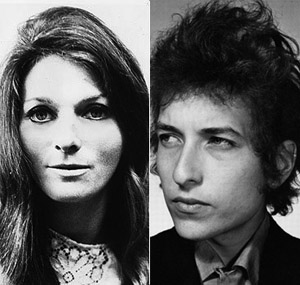


 In a series of posts, I will describe each of the six categories in brief, one at a time:
 Digital Citizen