What’s Your Song of Religion? (Part 5 of 7 on the World in Six Songs)

Share/Save/Bookmark
.

Book and Theory Background

Daniel J. Levitin wrote an absolutely brilliant book called The World in Six Songs, supported by a great website with the many music samples referenced, among other great related material.

My basic paraphrasing of the concept is this. All the songs in the world could be fit into at least one of six categories providing an evolutionary benefit to humanity, often ultimately tied to our social nature.

The book and website offer far more detailed interpretations, of course, but I will expand on my paraphrasing with each post and the associated topic.
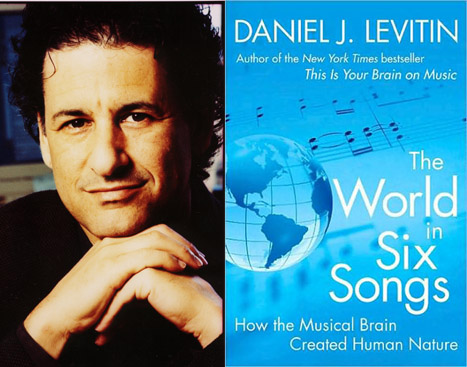
Daniel J. Levitin and The World in Six SongsIn a series of posts, I will describe each of the six categories in brief, one at a time:

  1. Friendship
  2. Joy
  3. Comfort
  4. Knowledge
  5. Religion
  6. Love

I will describe what the categories are about because they are not as limited in scope as the category names suggest. I will then supply one of my choices and ask all readers to do the same if they so wish. In the seventh post of the series, I will offer the chance to put the song choices all together so readers can read the entire set on one post. I do this because it would be a long post to describe all six categories at once, but to have all the answers in one place might be nice.

.

This post focuses on Songs of Religion

July 30th add-on in italics, from Dan Levitin in a summary article
Religious ceremonies and ritual go hand in hand, with music frequently accompanying a ritual. Music acts as a retrieval mechanism to guide the movements and words of a particular ritual, and ritual can allow people to stop worrying and focus on the task at hand. Music is also tied to religious ceremonies such as weddings and funerals where acts can be performed as a community, providing social bonding.

Songs of religion are not simply songs about religion. In fact, the songs of knowledge post showed how the Oral Torah was really a song of knowledge, not religion, even if its lyrics were all about religion. Songs of religion are really ritual songs intended to give meaning to something greater than just the subject itself. Furthermore, this meaning is attached to a belief system that establishes some sort of “social” order, both, less and more than us. It is this search for meaning, a self-conscious act of awareness on our part, for our place in this order which truly separates us from the rest of the animal kingdom. However, it is what we embrace in this search, in turn, that has benefited us in evolution.

In our search for something greater that is part of our religious beliefs, we embrace sets of rituals that exist in all religions. Religion gives meaning to these rituals that have little meaning on their own otherwise. Just look at rituals in religions foreign to you and see how you feel about them compared to those in your own. However, those not familiar with your religion would have no different overall reactions to rituals in your religion. Pages 194-195 has a great list of 11 rituals universal to all religions, though, which is an absolutely fascinating read!

Now, the rituals of religion come in two flavours: self-rituals and group rituals. Self-rituals tend to be of the type which promotes survival, like not murdering others or coveting their mates which could cause conflict among us that is not good for survival. Rituals also mean the actions get repeated, which helps survival if all the actions were good for survival. As for religion’s role, religion gives self-ritual self-meaning, like what it could mean for someone in their current and/or afterlife. Religion also monitors external and internal states for danger in guiding rituals to be done at various times throughout life.

Like it does for self-rituals, religion gives group rituals group meaning and monitors internal and external states to the group. This is the more important benefit to evolution when compared to the self. This is because group rituals promote group activities, which not only protect us from ourselves but also from other factors of harm to us, and better than individuals could do alone. Group rituals are essential to religion because one cannot find a place within a greater social order if there were no one or nothing else around oneself to create this social order.

Finally, all rituals, with their meanings given by religion, are intended to reduce ambiguity in life by changing the state of the world into something more exacting. It also lets us move on with our lives with the direction given so we don’t subject ourselves to situations not beneficial to our survival.

At this point, I would like to insert a note to say that while the general big picture descriptions of religion described in the World in Six Songs are beneficial to evolution, when it comes to the main organized religions in human history, I’m not sure I would concur. I think modern organized religions have become so warped from the spirit of religion’s concept I would debate whether it has had net benefit on humanity or net hindrance. Ironically, this has been since we supposedly have become “civilized”. So much wrong has been done in the name of organized religion, or hidden by it, that I really do think we could do better without it. I think we’d be better off if we only embraced religion in its intent rather than its meanings that it often has no business giving. Organized religion is just a pretense to guide us as if those leading it knew what were happening when they have no idea.

Songs associated with rituals mean there is a time and a place for songs of religion, with consequences. Thus, funeral and wedding marches count, but not national anthems or Christmas carols. There are places and times for national anthems, football fight songs and Christmas carols when you could break out in one or the other, and there wouldn’t be much problem. Try the same with funeral or wedding marches, especially the former, and there might well be. Children’s songs where participants move parts of their body selectively also count as songs of religion because of their ritualistic nature. This practice to develop motor coordination through repetition when we are young and learning is also of benefit to us evolutionally. Finally, gospel songs are religious songs, and it was mentioned that Dan Dennett had suggested that atheists should have pro science gospel songs as atheism doesn’t have gospel religious songs — a thought I, both, like and found tremendously amusing.

Audio sample of songs from the Religion chapter in The World in Six Songs can be found on the website. No direct link was available, but click on the Songs menu option and appropriate page number range link carrying pages 189 to 228. Please note that not all songs are meant as samples of Religion songs. Some are just referenced material in the book text.

Overall, I found this chapter on songs of religion to be very profound and deep, as it should be considering the subject matter. Despite the long post, I have only touched upon the many things Daniel Levitin touched upon for which there is much to think about each.

.

Author Daniel Levitin chose

.

My choice for Song of Religion is

Lacrymosa , by Wolfgang Amadeus Mozart from his incomplete Requiem (funeral music), K. 626, that is magnificent from beginning to end.

It seems the current opinion is that only the first 8 bars were actually written by Mozart, with the rest under instruction for completion. However, listening to it, sounds like the instructions were pretty complete to me.

I have had the pleasure to sing this piece in choir and, well, let’s just say when you hear this piece with all the parts around you, singing one part, that’s when you really “get” the genius of Mozart.

I have also heard this version sung whereby the choir stopped at where it was thought Mozart stopped composing (I believed that version was about 8 bars into the vocal section), and they just stopped dead and walked off. It was so moving, the reminder that Fate doesn’t care for what we do and stops where it wants, that I cried in realizing the finality of it all.

.

Frederic Chopin’s Funeral March, from his Sonata No. 2 in B flat minor, Op. 35, also works well. This version is by Vladimir Horowitz. Masterful!
(the music, not video which is just black which might be appropriate but boring as heck)

.

Andrew Lloyd Webber’s Pie Jesu from his Requiem is also a favourite of mine. I have also sung this in choir. Sissel Kyrkjebø does a beautiful job here!

.

I don’t know what to say about all the funeral music selections here. I LOVE classical funeral music for some reason. It gives me such peace and lets me focus incredibly well. I especially like writing anything I need to focus and be concise on to it. Obviously, I don’t blog to it. :-)

.

What is your choice for Song of Religion?

Please leave your choice as a comment.

Lyrics and YouTube/audio link would greatly enhance your answer so readers can know more about your choice. They are not necessary, though, and not possible if no lyrics or version exist.

You can include songs you wrote as a choice, too!

Flesch-Kincaid Grade Reading Level: 10.7

What’s Your Song of Knowledge? (Part 4 of 7 on the World in Six Songs)

Share/Save/Bookmark
.

Book and Theory Background

Daniel J. Levitin wrote an absolutely brilliant book called The World in Six Songs, supported by a great website with the many music samples referenced, among other great related material.

My basic paraphrasing of the concept is this. All the songs in the world could be fit into at least one of six categories providing an evolutionary benefit to humanity, often ultimately tied to our social nature.

The book and website offer far more detailed interpretations, of course, but I will expand on my paraphrasing with each post and the associated topic.

Daniel J. Levitin and The World in Six SongsIn a series of posts, I will describe each of the six categories in brief, one at a time:

  1. Friendship
  2. Joy
  3. Comfort
  4. Knowledge
  5. Religion
  6. Love

I will describe what the categories are about because they are not as limited in scope as the category names suggest. I will then supply one of my choices and ask all readers to do the same if they so wish. In the seventh post of the series, I will offer the chance to put the song choices all together so readers can read the entire set on one post. I do this because it would be a long post to describe all six categories at once, but to have all the answers in one place might be nice.

.

This post focuses on Songs of Knowledge

July 30th add-on in italics, from Dan Levitin in a summary article
Historically, songs have been used to transmit various information such as religious texts, survival and life lessons, and even the ABCs. Studies have shown information set to song is memorized more reliably than when simple rote memory is used. Increasing the reliability of transmitted information provides the next generation with valuable information.

Songs of knowledge are aptly named because they preserve and spread knowledge. However, it’s not that simple since we have language, which is a far more versatile means of conveying and preserving language than music, having far fewer limitations in composition. Language, though, doesn’t have nearly the mnemonic power of music to help preserve the knowledge being conveyed. This was of great value before we had written language, though it should be pointed out that Daniel Levitin did not pick sides whether the musical or linguistic brain came first. Rather, he favoured the likely to be correct idea they developed together. Another limitation of language is that it can be too specific.

For difficult or awkward situations, a little ambiguity afforded by songs might actually help dissolve conflict, or at least manage social uncertainty, benefiting survival. Songs are also more genuine because it is partly an emotional output, not a rational one, and not as easily to fake.

Finally, knowledge songs are performed by many people, and often. That is partly how they are maintained as per oral history. You can neither preserve nor spread songs if only one person knew it and/or it were rarely performed. Too risky to lose those songs and their knowledge forever. These songs are also sometimes sung in groups, which helps identify those who can bond into groups that increase chances of survival and promote evolution.

As for some examples, many kids’ songs like those which teach counting and the alphabets are excellent, albeit simple examples of knowledge songs. With English as my primary language, the Alphabet Song comes to mind.

.

This is the same tune as Twinkle, Twinkle, Little Star by the way, although the latter helps teach things like rhyme rather than an alphabetical sequence… kind of like the video link demonstrates hilariously.

.

However, on the other end of the spectrum is the Oral Torah, which, as a Christian metaphor if you are not familiar with it, is a bit like reciting the Bible by memory by song. That’s not entirely accurate, with the history of the Oral Torah being very interesting compared to the written Torah, but you get the idea. Despite the religious text, though, the “song” is meant to preserve and spread knowledge. Religious songs, covered next, are more about rituals. Finally, in the middle are songs like those sang by traveling minstrels and pop songs that tell of historical events like Gordon Lightfoot’s The Wreck of the Edmund Fitzgerald.

Audio sample of songs from the Knowledge chapter in The World in Six Songs can be found on the website. No direct link was available, but click on the Songs menu option and appropriate page number range link carrying pages 137 to 188. Please note that not all songs are meant as samples of Knowledge songs. Some are just referenced material in the book text.

Daniel Levitin talks more about the impact of songs in our lives, including songs of knowledge, in this video below.

.

Author Daniel Levitin chose

.

My choice for Song of Knowledge is

Woodstock, by Joni Mitchell (lyrics).

This was a really tough one for me to answer because I don’t live in a place and time of traveling minstrels and some choices I had thought about were covered (Wreck of the Edmund Fitzgerald). However, after thinking long and hard, I decided on my choice above. While not a full historical account by any means, Joni at least wasn’t there like most of the minstrel singers would not have been at the events about which they sang.

.

What is your choice for Song of Knowledge?

Please leave your choice as a comment.

Lyrics and YouTube/audio link would greatly enhance your answer so readers can know more about your choice. They are not necessary, though, and not possible if no lyrics or version exist.

You can include songs you wrote as a choice, too!

Flesch-Kincaid Grade Reading Level: 10.3

What’s Your Song of Joy? (Part 2 of 7 on The World in Six Songs)

Share/Save/Bookmark
.

Book and Theory Background

Daniel J. Levitin wrote an absolutely brilliant book called The World in Six Songs, supported by a great website with the many music samples referenced, among other great related material.

My basic paraphrasing of the concept is this. All the songs in the world could be fit into at least one of six categories providing an evolutionary benefit to humanity, often ultimately tied to our social nature.

The book and website offer far more detailed interpretations, of course, but I will expand on my paraphrasing with each post and the associated topic.

Daniel J. Levitin and The World in Six SongsIn a series of posts, I will describe each of the six categories in brief, one at a time:

  1. Friendship
  2. Joy
  3. Comfort
  4. Knowledge
  5. Religion
  6. Love

I will describe what the categories are about because they are not as limited in scope as the category names suggest. I will then supply one of my choices and ask all readers to do the same if they so wish. In the seventh post of the series, I will offer the chance to put the song choices all together so readers can read the entire set on one post. I do this because it would be a long post to describe all six categories at once, but to have all the answers in one place might be nice.

.

This post focuses on Songs of Joy

July 30th add-on in italics, from Dan Levitin in a summary article
Joy songs are associated with celebration, moments that inspire people to sing, jump, dance and shout. It has been shown that singing releases oxytocin (the hormone released during orgasm), and music listening releases serotonin (a mood-regulating neurotransmitter commonly used in antidepressants). The positive effect of singing or listening to music has also been found to have a positive effect on the immune system, which creates an evolutionary advantage.

These songs celebrate something and reward us for actions that benefit our survival so we would do it again to further improved the odds. “Rewards” are in terms of brain chemicals like oxytocin and serotonin, we naturally release when we feel happy or having performed acts which make us happy. Rewards could also come in reductions of chemicals which do not make us happy, like cortisol and prolactin, which may lead to actions the reduce our chances of survival like violence, reduced physical growth, depression, etc. Additional action of celebration benefits us in a wide range of ways, from the seemingly trivial to the more internal and less visible, like:

  • Dancing, stretching, jumping or other natural movements to music which are good for our physical well-being;
  • True emotions, which arise out of benefiting our survival.

In a fascinating argument which I buy into, Daniel Levitin argues that emotions like jealousy are not “true” emotions. Rather, they are “adaptations” to adversity to minimize harm rather than directly benefiting our survival directly. They do not “reward” us in the sense of making us want to repeat actions over and over to benefit our survival. Daniel didn’t say the latter, stating nature does not build systems which defeats itself. However, in trying to keep things simple, that was my conclusion. No doubt, while there are insecure people jealous of everyone else for any number of reasons, most of us would readily admit we could do without jealousy in our lives if we could.

We possess the reward systems of joy today because those of us who enjoyed music of joy, like any of the other categories, were the ones who survived to successfully pass on the genes that allow us to enjoy such music.

As an additional point, Daniel Levitin did not address funny songs in his book. At least I didn’t find anything obvious. One could easily argue that they fall under songs of Friendship because laughing together promotes stronger relationship. I, for one, totally believe that as a major icebreaker to break cultural barriers, to me, is if you can learn to laugh at yourselves and then at each other. But even more, I believe in that anecdote that laughter is the best medicine, and as a result, laughing is good for survival and evolution. So if songs of Joy rewards us for things we should try to do more and more of, songs that makes us laugh should fall here.

Audio sample of songs from the Joy chapter in The World in Six Songs can be found on the website. No direct link was available, but click on the Songs menu option and appropriate page number range link carrying pages 83 to 110. Please note that not all songs are meant as samples of Joy songs. Some are just referenced material in the book text.

.

Author Daniel Levitin choose

.

My choice for Song of Joy is

Walking on Sunshine, an 80s tune by Katrina and the Waves (lyrics).

It is a joyful song, for sure, and one that definitely makes me want to get out of my seat and dance. I’m standing over the keyboard dancing right now as I’ve got the YouTube version playing to get the link for it! However, this is by no means a definitive choice for me. I can’t say songs of Joy are among the most prominent songs on my mind. I’ve got tons of them as it makes it easier to become happy that way, but in terms of distinctive favourites, none grabs me enough to say “yeah, that’s the one!”

Now, if you’re talking songs of Joy as in humour, my choice would be Nellie McKay‘s Clonie (partial lyrics). Good songs of humour are rare for me, but this one does the job well. I love a lot of her witty, funny and charming music, which I only discovered recently.

.

What is your choice for Song of Joy?

Please leave it as a comment.

Lyrics and YouTube/audio link would greatly enhance your answer so readers can know more about your choice. They are not necessary, though, and not possible if no lyrics or version exist.

You can include songs you wrote as a choice, too!

Flesch-Kincaid Grade Reading Level: 11.0

What’s Your Song of Friendship? (Part 1 of 7 on the World in Six Songs)

Share/Save/Bookmark
.

Book and Theory Background

Daniel J. Levitin wrote an absolutely brilliant book called The World in Six Songs, supported by a great website with the many music samples referenced, among other great related material.

My basic paraphrasing of the concept is this. All the songs in the world could be fit into at least one of six categories providing an evolutionary benefit to humanity, often ultimately tied to our social nature.

The book and website offer far more detailed interpretations, of course, but I will expand on my paraphrasing with each post and the associated topic.

Daniel J. Levitin and The World in Six SongsIn a series of posts, I will describe each of the six categories in brief, one at a time:

  1. Friendship
  2. Joy
  3. Comfort
  4. Knowledge
  5. Religion
  6. Love

I will describe what the categories are about because they are not as limited in scope as the category names suggest. I will then supply one of my choices and ask all readers to do the same if they so wish. In the seventh post of the series, I will offer the chance to put the song choices all together so readers can read the entire set on one post. I do this because it would be a long post to describe all six categories at once, but to have all the answers in one place might be nice.

.

This post focuses on Songs of Friendship

July 30th add-on in italics, from Dan Levitin in a summary article
Friendship songs centre around group cohesion, whether it be for war, or the bonding of different cliques in high school. For example, in prehistoric warfare, attackers would sometimes ambush another tribe using loud instruments (especially drums) to surprise the targets while they were still sleeping. Countertactics employing the use of singing may also have been used as a signal that the group was awake.  These songs serve to protect a tribe/group or succeed in the takeover of another. In the context of social groups, they provide a sense of community and belonging, bringing people together.

These songs serve the purpose of bringing people together to promote cooperation in one form or another in order to survive, or at least make life more tolerable. Applied to various situations, cooperation could promote any of these situations:

  • Working together
  • Attacking/defending together
  • Supporting each other
  • Friendship
  • Averting conflict
  • Forging group identity (maybe not formally but like a bonding anthem for a group of “outcasts”)
  • Others

The evolutionary value is that humans interact socially, whether in friendly or destructive ways. If we can avoid the latter, like in wars, we are more likely to survive and thrive as a species. Our social bonds are essential to our well-being, and we do survive and thrive better in groups, so anything that helps us in these causes are beneficial to our evolution as a species.

Audio sample of songs from the Friendship chapter in The World in Six Songs can be found on the website. No direct link was available, but click on the Songs menu option and appropriate page number range link carrying pages 41 to 82. Please note that not all songs are meant as samples of Friendship songs. Some are just referenced material in the book text.

.

Author Daniel Levitin chose

.

My choice for Song of Friendship is

You’ve Got a Friend by Carole King (lyrics).

It fits into the Friendship subcategory of various bonding purposes, but I do believe that true friends ultimately help each other. There isn’t any other song I know and feel tells someone they’ve got a true friend better than this Carole King song. Nobody sings it better, either!

.

What is your choice for Song of Friendship?

Please leave your choice as a comment.

Lyrics and YouTube/audio link would greatly enhance your answer so readers can know more about your choice. They are not necessary, though, and not possible if no lyrics or version exist.

You can include songs you wrote as a choice, too!

Flesch-Kincaid Grade Reading Level: 10.5