This is meant to be a quick assessment for the Big Five personality traits currently favoured by academic psychology (Conscientiousness, Agreeableness, Neuroticism, Openness, and Extraversion – CANOE or OCEAN). Supposedly, it has excellent reliability and validity to measure someone’s Big Five results compared to the 240 question Revised NEO Personality Inventory (NEO PI-R), developed by Paul Costa and Robert R. McCrae. Of course, the TIPI is more prone to error than the NEO PI-R, but it is ideal for those who don’t have the time or the resource to do the NEO PI-R, and might be a good introduction for the CANOE theory and how you fare with it.
assessment
Positive and Negative Affect Schedule (PANAS) Assessment
The Positive And Negative Affect Schedule (PANAS) gives you an idea of your natural mix of happiness and unhappiness by measuring one’s general levels of positive and negative mood — or affect — and whether you tend to experience higher or lower positive and negative emotional states than average. There is neither “right” or “wrong” outcome, nor “best” or “worse”. Each outcome has its advantages and drawbacks. Knowing your mix will allow you, if you so choose, to best use it for effect and impact pending a situation and the way you tend to be.
To take the assessment, find a time when you feel relatively neutral about life, and not when you are more stressed or happy than normal. Then answer 20 questions about how deeply you feel a series of emotions.
Answer in general, or on average — not at this very moment. Use the text below or this PDF if you’d like to do it on a printout.
You have five possible answers for each emotion:
- 1 = very slightly or not at all
- 2 = a little
- 3 = moderately
- 4 = quite a bit
- 5 = extremely
Assign the scores above to the following 20 emotions:
1. Interested _______
2. Distressed _______
3. Excited _______
4. Upset _______
5. Strong _______
6. Guilty _______
7. Scared _______
8. Hostile _______
9. Enthusiastic _______
10. Proud _______
11. Irritable _______
12. Alert _______
13. Ashamed _______
14. Inspired _______
15. Nervous _______
16. Determined _______
17. Attentive _______
18. Jittery _______
19. Active _______
20. Afraid _______
Tallying results
- Calculate your positive affect by summing your scores for questions 1, 3, 5, 9, 10, 12, 14, 16, 17, and 19.
- Calculate your negative affect by summing your scores for questions 2, 4, 6, 7, 8, 11, 13, 15, 18, and 20.
Which PANAS type are you?
Remember, there is neither “right” or “wrong” outcome, nor “best” or “worse”. Each outcome has its advantages and drawbacks. Knowing your mix will allow you, if you so choose, to best use it for effect and impact pending a situation and the way you tend to be.
Unless you are the highly unusual person who is right at the average on both positive (33.3) and negative (about 17.4), you will fall into one of four quadrants.
- If you have above-average positive affect (>33.3) and above-average negative affect (>17.4),
you’re a “Mad Scientist” who is always spun up about something. - If you’re above-average positive (>33.3) and below-average negative (<17.4),
you’re a “Cheerleader” who celebrate the good in everything and don’t dwell on the bad. - If you’re below-average positive (<33.3) and above-average negative (>17.4),
you’re a “Poet” who has trouble enjoying good things, but know when there’s a threat lurking. - If you’re below-average positive (< 33.3) and below-average negative (<17.4),
you’re a “Judge” who is sober and cool about everything.
Further interpreting the results
While there is no “best” or “worst”, “good” or “bad”, “right” or “wrong” PANAS type to be, you may doubt that or wish you were another type you perceive to be “better”. There is no easy way to possibly convince you otherwise, but perhaps an example of why it is bad if everyone were each type would convince you why all four types are needed, and quite possibly equally.
- If everyone were a Cheerleader and only saw the bright side of everything, we’d keep making the same mistakes repeatedly, which would be awful.
- Judges, meanwhile, keep us safe from what unrestrained and endless impulsivity may sometimes, or ultimately, lead to.
- Poets keep us alert to threats, even if everything might seem like a threat at times when some aren’t and would just slow down progress or prevent it all together.
- Finally, Mad Scientists keep life interesting by making everything grandiose, good and bad, when a lot, if not most things, clearly aren’t.
Every PANAS type has its advantages and disadvantages for all and each situation. Part of knowing your PANAS type is to know where you might fit best or be able to use your PANAS strengths best, and to avoid circumstances where your PANAS type isn’t naturally suited as it’d be more work, and more risk of negative outcomes, to achieve the level of goodness for outcomes in circumstances where your PANAS type belongs more naturally.
More information
You can find more information on the PANAS, outcomes, meaning, and use, on these sites and pages within them:
Fashion Scientist or Engineer?
 From this No Stupid Questions podcast episode, I heard that mathematician Richard Hamming thought “in science, if you know what you are doing, you should not be doing it; in engineering, if you don’t know what you are doing, you should not be doing it”. That is, scientists are explorers, while engineers are executioners. It’s not an absolutely line. Nothing is, and especially in situations like this where neither side doesn’t know anything about what they’re doing. You need to know some things to plan to do it in some way, and you need to do some things you don’t know everything about. So maybe it’s a majority sort of thing. But it let me to consider if I were more of a scientist or engineer when it comes to fashion design, where, in addition to designing, I often alter or create thing for some purpose.
Introversion / Extraversion Assessment from Scientific American on Excel

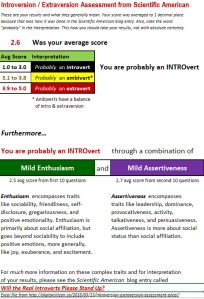 On June 9th, 2014, the Scientific American blog Beautiful Minds had a rather in-depth article called Will the Real Introverts Please Stand Up? about what introversion really meant (and extraversion as the opposite). The term is still highly misunderstood, whether from generic social definitions, or more precise and complex definitions through the works of Myers-Briggs and others following.
In the Beautiful Minds article, they had a 20 question quiz written out. Some score adjustments were then required after you answered, followed by averaging your newly adjusted scores, and averaging two halves of your score if you wanted more information. In this post with an Excel spreadsheet attachment below, I have made this test a lot easier to take. You just answer the questions and flip through the process to see your results! There is a minor summary of your results, but you’d then go back to the original article linked above for the full details.
My Personality Assessment Now Available as an iOS App!
 I’m very delighted to share the news that my Personality Assessment based on work by Jung, Myers, Briggs and Keirsey
is now available as a free iOS app in the iTunes App Store!
A huge thank you to Shawn Seymour, a student at the University of Minnesota, Morris, for creating the app for free so you all can use it for free!
Since it was his project and app, I pretty left it all to him and he did a fantastic job!
- The design is simple and elegant.
- The colour scheme is beautiful.
- He kept the text short and simple.
- He even randomized the questions which I had wanted to do but could not easily do in my Excel version!
I am just delighted with out it turned out, but I shouldn’t be surprised given what else Shawn Seymour has done as seen on his site.
I’ve been wanting to turn my test into an app for a few years now seeing where the tech interface of choice was going. However, I couldn’t find a good app programming course / diploma in my area so I’m very happy Shawn was able to do this for me, and made it freely available for everyone when I asked him to do so.
Please tell others about the app if they can access it, or if the Excel format had stopped you from being able to try it before.
Thank you VERY much, Shawn! 🙂
 Digital Citizen