The Tipping Point Numbers for Social Change

These are targets every person or group trying to instill social change needs to know to gauge the likelihood or their success.

Recent research has shown that for true social change to occur, you’d need 7-10% of a population to hold an unshakable belief to be able to change the belief of that population within a reasonable amount of time. This is as long as there isn’t another group with another unshakable belief opposing it, like a different religion (Discovery News, August 6 2011). Combine that with the 1% you need to start a movement (Microtrends, by Mark Penn) and you’ve got two real targets for any organization seeking to create lasting social change. There’s none of those around these days, are there? 🙂

Continue reading

Earth Day Goal 2010 Achieved, What to Pledge for 2011?

Happy Earth Day to you,
Happy Earth Day dear reader,
Happy Earth Day to you!

What are you going to do,
To keep sea and sky blue,
To reduce your C-O-2,
To be green the year through?

HAPPY EARTH DAY, EVERYBODY!

On Earth Day 2010, I pledged to eat “better” as my Earth Day goal for the year from that day.By “better”, I meant more local and more unprocessed foods, though I didn’t start out defining them that way, nor for the green reasons of food miles. Once I researched more and came to conclude food miles was a myth, though, I ate better for the economy and for my health. I’m sure it still has an environmental impact because I didn’t end up eating food grown in green houses here in the Canadian winter, that would have used up tonnes of excessive energy, but without being able to measure it, I couldn’t claim it for certain. One thing I am more certain, though, is that it saved me money not to be eating out so much as before given I don’t eat processed foods like frozen dinners that tend to be on the cheaper side, though I did eat more fast food than I should have.

Continue reading

The Real Shit on Biosolids

There’s a lot of shit going down in Halifax these days in the fight over the safety of biosolids, or human sewage used for fertilizers.

One side is claiming they can get all the bad shit out of the people’s shit so it’s safe to use. The other is claiming there’s no way that shit can be clean and appealing to people’s feelings on eating food grown in shit. I’m not going to advocate for either side because I don’t know shit about the shit data, but I don’t need to. What I will do is point out some interesting shit people who don’t know shit seem to be neglecting that makes this whole shit spit irrelevant. There are some healthy food that’s not subject to this, but most people don’t eat that shit when you look at the big picture.

First, would you rather eat food grown in your shit or someone else’s shit?

A lot of food in the grocery stores are grown in other places, fertilized by other people’s shit. California, Mexico, China and other places all allow shit to be used as fertilizers, and a lot of shit, too! (Halifax Herald story, with research from the Nova Scotia Environmental Network, via the Organic Consumers Association)

So are you telling me you’d rather eat food grown in their shit rather than food grown in your shit?

Hey, lots of people have prejudices against Chinese and Mexicans. They make lots of jokes about them, too. Ironically, the last laugh may be on those people cause they’re probably eating food grown from Chinese and Mexican shit. Ewwhahaha!

You and I are probably eating food grown from foreign shit, too. Maybe not fresh food as you may get your fresh food locally, but think about the processed food. Do you know where all of it comes from?

To be honest, though, if I had to eat food grown from people’s shit, I might well eat those grown from other people’s shit. Part of the fear about eating food grown in our own shit is all the chemicals we ingest that can’t get filtered out, especially drugs we take for illnesses or lifestyle, like birth control pills. The boomer generation is by far the most drugged up generation ever. In poorer parts of the world, those people don’t have access to such “luxuries”. I’d be willing to bet their shit is a lot cleaner than ours and would take the risk to eat food grown from their shit rather than ours. It’s just that they have pesticides and other chemicals that probably make them more harmful overall.

Second, would you rather eat food grown from animal shit than your own shit?

Have you seen or heard about the shit that’s been going into animal feed lately? There’s everything from growth hormones to genetically modified crops to low quality reject foods, and very possibly more of that shit than real food! Those animals are, well, animals! What did you think they were, people, to be worth feeding better shit to? And the shit they get fed is nasty shit, even in the world of shit! Birth control pills and medications are like organically grown peanuts compared to that shit. Watch Food Inc. on this site to get a little taste, though the superb documentary covers a lot more shit than that and is real good shit for anybody to know about the nature of the food they eat.

Animal shit has been used as nature’s fertilizer over the millennia. However, that was when animals ate stuff Mother Nature fed them, not the shit we’re feeding them today. If you know all the shit the animals you eat are fed, whose shit fertilizes fields other food you eat are grown in, I’d be willing to bet you’d take food grown from your own shit any day!

Finally, why are you concerned about fresh food grown in shit compared to all that processed shit you’re eating?

Seriously, few people these days don’t eat processed food, whether frozen dinners or fast food, not to mention drinking pop. Obesity is an epidemic for a reason, you know, not to mention a lot of other health conditions stemming from shitty diets. A little shit here or there that gets through from food grown in shit, or food fed shit in the case of animals, is nothing compared to all that bad shit out there people are eating. Even the good shit, if frozen or processed to much like frozen organic entrees, isn’t all that good shit to be eating.

Conclusions

All in all, worrying about a little shit that might get through after Mother Nature, and possibly filtration plants, have filtered your shit in which you grow your food is misplacing your concerns. There’s a whole lot of other shit out there you ought to be raising shit about.

All right. Enough of this shit.

I hope I won’t get in trouble for talking about this shit…

Oh, shit.

Some Thoughts and Statistics on the New Seaport Farmers’ Market in Halifax

The new Seaport Farmers’ Market in Halifax is almost in full swing now. It is now open 3 days a week, Fri-Sun, and much longer each day than the half day before at the old market that was open just once per week Sat morning. The future intent is for the new market to be open 6 days a week, though the farmers will only be there for 3. The other 3 days will only have craft sellers. It’s a nice big space and I love it, although I hear the busking musicians are disgruntled due to the open space leaving all of them to be heard so they have to compete to get above each other (The Coast, Sep 9 2010). Hey, I like the music and appreciate its contribution to the ambiance of a farmers’ market, but it’s a new farmers’ market building, not a concert hall.

I love the additional selection and larger stands, though I have to curb myself on the cooked food. It smells and tastes great, but just see how much raw food you can get for the same amount of money on a cooked plate, and you’ll not only see the value of labour to your food costs, but also where many of those cents to your food dollar that’s not going to the farmers end up going. Going there with someone who might expect you to buy something, which includes yourself, is also going to be costly with all the potential little craft trinkets you can buy for significant others, kids, etc. It’s great to see all the stuff, but is hard to resist. So far, I have bought nothing other than raw food from the farmers.

I’ll leave with some statistics about the farmers’ market scene in Nova Scotia and the Seaport Farmers’ Market, from various sources like The Coast paper and the Canadian Broadcasting Corporation (CBC).

  • 40 Nova Scotia Farmers’ Markets Sep 2010, few opened all week
  • New farmers’ market is in an R-2000 building (NRCan designation) that uses 85% less energy and 50% less water than old market
    R2000-standard PDF
  • New farmers’ market is twice the size of old market (which is still open) at 4,000 sq feet
  • 10,000+ visitors per Saturday (August figures, but is still as crowded as far as I can tell)
  • Total vendors increased by at least 50% between new and old markets opening, though not all are food vendors
  • NS Community Supported Agriculture farms (CSAs) and farmers’ market bring in about $90M a year (and growing) to farmers (includes prepared foods, possibly crafts, so can’t just take it against farm gate)

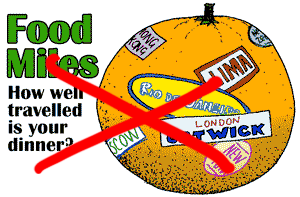
The Food Miles Myth – Eat Local for the Economy, Not the Environment

Food miles is a nice concept for awareness, but a meaningless and impractical ideal to believe in for eating local. Eat local for the economy, not the environment. It doesn’t sound as “romantic”, to idealize something for money rather than for the Earth. However, you’re likely idealizing something you wouldn’t be able to prove to be true.

Continue reading