PERMA Flourishing Inventory (Science of Well-being Week 1 Optional Rewirements)

The Science of Well-being course’s Week 1 Rewirements also recommended, but not required, other tests in the greater Authentic Happiness Inventory. The course especially recommended the PERMA™ (an acronym for Positive emotion, Engagement, Relationships, Meaning, and Accomplishment— the basic dimensions of psychological flourishing). Since they asked those who take it to keep score, I took it to get the most out of the course.

But first, I had to find out what psychological flourishing was. From Wikipedia, flourishing is described as “a state where people experience positive emotions, positive psychological functioning and positive social functioning, most of the time,” living “within an optimal range of human functioning.” If I were to describe it in plain language, it’s how positive someone is in a general lifestyle range (rather than in distress or euphoria moments or spans of time). Further from Wikipedia, flourising is a descriptor and measure of positive mental health and overall life well-being, and includes multiple components and concepts, such as cultivating strengths, subjective well-being, “goodness, generativity, growth, and resilience.” Flourishing is the opposite of both pathology and languishing, which are described as living a life that feels hollow and empty. It is a central concept in positive psychology, developed by Corey Keyes and Barabara Fredrickson.

If you want to know more about the dimensions, which I will cover with my PERMA results, I found a more comprehensive description on the Positive Psychology Program site.

Continue reading

First Try with Anki Cozmo Robot’s SDK

Last night, I had my first look into the Anki Cozmo robot’s SDK that uses Python. It was a little nerdy to install and set up, but the videos were well put together. Now, the real fun begins!

My strategy for learning these programs is to alter them in some way, to be creative but also to get some hands on coding done, and maybe to do some independent things rather than just following instructions without having to think much. It’s one thing to repeat words and phrases to learn a language. It’s another to make your own, or at least tweak, the words and phrases you got taught. I learn much better the latter way.

Continue reading

Introversion / Extraversion Assessment from Scientific American on Excel

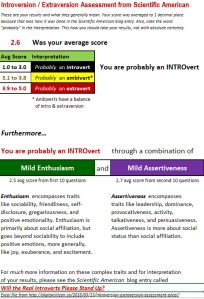
introversion extraversion assessmentOn June 9th, 2014, the Scientific American blog Beautiful Minds had a rather in-depth article called Will the Real Introverts Please Stand Up? about what introversion really meant (and extraversion as the opposite). The term is still highly misunderstood, whether from generic social definitions, or more precise and complex definitions through the works of Myers-Briggs and others following.

In the Beautiful Minds article, they had a 20 question quiz written out. Some score adjustments were then required after you answered, followed by averaging your newly adjusted scores, and averaging two halves of your score if you wanted more information. In this post with an Excel spreadsheet attachment below, I have made this test a lot easier to take. You just answer the questions and flip through the process to see your results! There is a minor summary of your results, but you’d then go back to the original article linked above for the full details.

Continue reading

My Personality Assessment Now Available as an iOS App!

personality-assessment-appI’m very delighted to share the news that my Personality Assessment based on work by Jung, Myers, Briggs and Keirsey

is now available as a free iOS app in the iTunes App Store!

A huge thank you to Shawn Seymour, a student at the University of Minnesota, Morris, for creating the app for free so you all can use it for free!

Since it was his project and app, I pretty left it all to him and he did a fantastic job!

  • The design is simple and elegant.
  • The colour scheme is beautiful.
  • He kept the text short and simple.
  • He even randomized the questions which I had wanted to do but could not easily do in my Excel version!

I am just delighted with out it turned out, but I shouldn’t be surprised given what else Shawn Seymour has done as seen on his site.

I’ve been wanting to turn my test into an app for a few years now seeing where the tech interface of choice was going. However, I couldn’t find a good app programming course / diploma in my area so I’m very happy Shawn was able to do this for me, and made it freely available for everyone when I asked him to do so.

Please tell others about the app if they can access it, or if the Excel format had stopped you from being able to try it before.

Thank you VERY much, Shawn! 🙂

Quick Six Question Facebook Addiction Test

The Bergen Facebook Addiction Test was developed by Cecilie Schou Andreassen, Doctor of Psychology and head of the Facebook Addiction study at the University of Bergen (UiB). It consists of six quick questions, which is great to get through. However, it is self-diagnosed. So if you are in denial about how you should truly answer the question, well, the test won’t identify you as a Facebook addict and you’ll continue to be in denial.

Continue reading