Guitar and Ukulele Tabs for Blueberry Hill (Louis Armstrong Extra Lyrics Version)

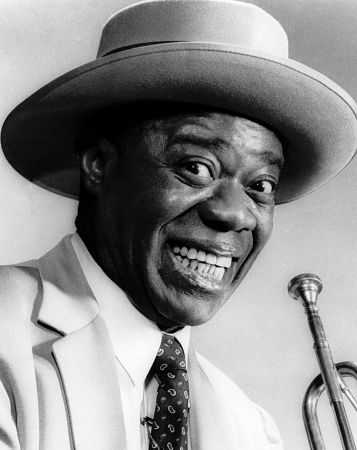
Louis Armstrong, "Satchmo"

There are tons of guitar tabs online, so why am I posting guitar tabs on my blog? Two words: more information.

More information which will help you figure out what was on my mind in creating every part of the tab and decipher it better if you use it. And for me, I eventually will have my guitar tabs set online so I can access it from anywhere that has an Internet connection!

The main problem with guitar tabs is that there is so little information compared to sheet music that you can’t hope to know what was going through the tabber’s mind when certain chords were written out. They might have been listening to a version of the song you weren’t. They might have arranged it a little differently because they sang it a little differently than the version they referenced. Sometimes they do this because with just one guitar instead of a band, certain things just don’t sound good so void of other musical support (a sign of a bad song). But overall, let’s face it, the general guitar tabs out there isn’t professional quality stuff. That’s why there are so many versions for each song.

With some advances to blogging and web technology, as well as efforts of others to post things, the guitar tabs I present will have more feature containing information you can reference to learn them and/or modify them for your own versions. First, I will have videos with recordings of the pieces I referenced so you can hear them for yourself. Second, there are notes written out, even if just letters rather than sheet music style. Notes an octave apart will be identified by capital letters for the higher notes. That way, if I modified anything, you can figure it out and understand what I did, then decide for yourself if you want to leave it or change it yourself. Finally, the chords appear exactly where they should be as I change them so there is no doubt.

In my first guitar tab on this blog, I present an exotic version of Blueberry Hill, the Fats Domino classic many people know, some of whom via the favourite song of Richie Cunningham from the Happy Days sitcom from 1974-1984. Fats’ version is the bottom of two videos below, included for comparative purposes. The version I present is by Louis Armstrong, from 1949 and recorded in Canada, no less! I like it because has a whole bunch of extra lyrics, with some scatting, that will either challenge you or allow you to duet with someone. Its video is below, meant to accompany the guitar tab above, although you’ll probably want to do it at a much slower, nostalgic sort of tempo to squeeze everything in.

One day soon, I hope to record a version so I can really demonstrate how I envisioned it to be played with solo guitar or ukulele, and not just ask you to figure it out from the video below.

I hope you enjoy!

All I Want is You, U2 Guitar Tabs Letter Sized PDF

All I Want is You, U2 Guitar Tabs Tabloid Sized PDF

All I Want is You, U2 Ukulele Tabs Letter Sized PDF

All I Want is You, U2 Ukulele Tabs Tabloid Sized PDF

These tabs all fit on one page to avoid the inconvenience of page turns. However, the letter size tabs (8.5″ x 11″) may be too small for your eyes. If so, you can either enlarge to tabloid size (11″ x 17″) using an automatic enlarge feature on many photocopiers, or download the tabloid sized versions for printing. The tabloid size tabs can be inserted into a typical letter sized binder on the 11″ size, and folded almost in half to fit. You just open each tab to use it.

Please click here for guitar and ukulele tabs and chords to other songs on this blog.


Louis Armstrong’s version of Blueberry Hill

Artist: Louis Armsrtong with Gordon Jenkins and His Orchestra
Title: “Blueberry Hill” (Lewis-Stock-Rose)
Label: Decca Personality
Cat No: 24752-B
Release Year: 1949
Country: Canada
Format: 10″ Shellac Record
Thanks to VinyltoVideo YouTube user for the post!

Fats Domino’s well-known version of Blueberry Hill

Flesch-Kincaid Grade Reading Level: 9.1

What’s Your Song of Knowledge? (Part 4 of 7 on the World in Six Songs)

Share/Save/Bookmark
.

Book and Theory Background

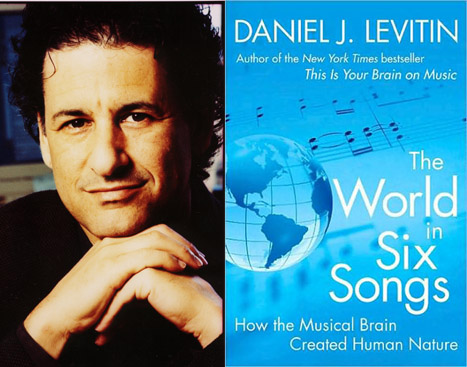
Daniel J. Levitin wrote an absolutely brilliant book called The World in Six Songs, supported by a great website with the many music samples referenced, among other great related material.

My basic paraphrasing of the concept is this. All the songs in the world could be fit into at least one of six categories providing an evolutionary benefit to humanity, often ultimately tied to our social nature.

The book and website offer far more detailed interpretations, of course, but I will expand on my paraphrasing with each post and the associated topic.

Daniel J. Levitin and The World in Six SongsIn a series of posts, I will describe each of the six categories in brief, one at a time:

  1. Friendship
  2. Joy
  3. Comfort
  4. Knowledge
  5. Religion
  6. Love

I will describe what the categories are about because they are not as limited in scope as the category names suggest. I will then supply one of my choices and ask all readers to do the same if they so wish. In the seventh post of the series, I will offer the chance to put the song choices all together so readers can read the entire set on one post. I do this because it would be a long post to describe all six categories at once, but to have all the answers in one place might be nice.

.

This post focuses on Songs of Knowledge

July 30th add-on in italics, from Dan Levitin in a summary article
Historically, songs have been used to transmit various information such as religious texts, survival and life lessons, and even the ABCs. Studies have shown information set to song is memorized more reliably than when simple rote memory is used. Increasing the reliability of transmitted information provides the next generation with valuable information.

Songs of knowledge are aptly named because they preserve and spread knowledge. However, it’s not that simple since we have language, which is a far more versatile means of conveying and preserving language than music, having far fewer limitations in composition. Language, though, doesn’t have nearly the mnemonic power of music to help preserve the knowledge being conveyed. This was of great value before we had written language, though it should be pointed out that Daniel Levitin did not pick sides whether the musical or linguistic brain came first. Rather, he favoured the likely to be correct idea they developed together. Another limitation of language is that it can be too specific.

For difficult or awkward situations, a little ambiguity afforded by songs might actually help dissolve conflict, or at least manage social uncertainty, benefiting survival. Songs are also more genuine because it is partly an emotional output, not a rational one, and not as easily to fake.

Finally, knowledge songs are performed by many people, and often. That is partly how they are maintained as per oral history. You can neither preserve nor spread songs if only one person knew it and/or it were rarely performed. Too risky to lose those songs and their knowledge forever. These songs are also sometimes sung in groups, which helps identify those who can bond into groups that increase chances of survival and promote evolution.

As for some examples, many kids’ songs like those which teach counting and the alphabets are excellent, albeit simple examples of knowledge songs. With English as my primary language, the Alphabet Song comes to mind.

.

This is the same tune as Twinkle, Twinkle, Little Star by the way, although the latter helps teach things like rhyme rather than an alphabetical sequence… kind of like the video link demonstrates hilariously.

.

However, on the other end of the spectrum is the Oral Torah, which, as a Christian metaphor if you are not familiar with it, is a bit like reciting the Bible by memory by song. That’s not entirely accurate, with the history of the Oral Torah being very interesting compared to the written Torah, but you get the idea. Despite the religious text, though, the “song” is meant to preserve and spread knowledge. Religious songs, covered next, are more about rituals. Finally, in the middle are songs like those sang by traveling minstrels and pop songs that tell of historical events like Gordon Lightfoot’s The Wreck of the Edmund Fitzgerald.

Audio sample of songs from the Knowledge chapter in The World in Six Songs can be found on the website. No direct link was available, but click on the Songs menu option and appropriate page number range link carrying pages 137 to 188. Please note that not all songs are meant as samples of Knowledge songs. Some are just referenced material in the book text.

Daniel Levitin talks more about the impact of songs in our lives, including songs of knowledge, in this video below.

.

Author Daniel Levitin chose

.

My choice for Song of Knowledge is

Woodstock, by Joni Mitchell (lyrics).

This was a really tough one for me to answer because I don’t live in a place and time of traveling minstrels and some choices I had thought about were covered (Wreck of the Edmund Fitzgerald). However, after thinking long and hard, I decided on my choice above. While not a full historical account by any means, Joni at least wasn’t there like most of the minstrel singers would not have been at the events about which they sang.

.

What is your choice for Song of Knowledge?

Please leave your choice as a comment.

Lyrics and YouTube/audio link would greatly enhance your answer so readers can know more about your choice. They are not necessary, though, and not possible if no lyrics or version exist.

You can include songs you wrote as a choice, too!

Flesch-Kincaid Grade Reading Level: 10.3