In the past, I have set annual Earth Day goals to work on for the “environmental year”. For example, I pledged to reduce my possessions by 3X my weight in 2009. I still don’t own a car and rarely ever take a cab, opting for public transit and walking mostly… by choice. I recycle a lot. I’ve become much better at energy usage than before, including turning off just about everything any time I’m away for more than 3 days. The freezer is usually the exception. I eat more locally and seasonally now, and so on. I plan to upkeep all this, of course, but have one more thing to add for the 2012-13 “environmental year”.
With my new foray into sewing and fashion since last fall, though, this will be the area of my Earth Day environmental focus for this upcoming “environmental year”. Below is what I plan to do to start. However, because I need to do a lot more research in this, I will have to add more specifics as I go along. Any suggestions anybody’s got is much appreciated. Thanks!
The new Seaport Farmers’ Market in Halifax is almost in full swing now. It is now open 3 days a week, Fri-Sun, and much longer each day than the half day before at the old market that was open just once per week Sat morning. The future intent is for the new market to be open 6 days a week, though the farmers will only be there for 3. The other 3 days will only have craft sellers. It’s a nice big space and I love it, although I hear the busking musicians are disgruntled due to the open space leaving all of them to be heard so they have to compete to get above each other (The Coast, Sep 9 2010). Hey, I like the music and appreciate its contribution to the ambiance of a farmers’ market, but it’s a new farmers’ market building, not a concert hall.
I love the additional selection and larger stands, though I have to curb myself on the cooked food. It smells and tastes great, but just see how much raw food you can get for the same amount of money on a cooked plate, and you’ll not only see the value of labour to your food costs, but also where many of those cents to your food dollar that’s not going to the farmers end up going. Going there with someone who might expect you to buy something, which includes yourself, is also going to be costly with all the potential little craft trinkets you can buy for significant others, kids, etc. It’s great to see all the stuff, but is hard to resist. So far, I have bought nothing other than raw food from the farmers.
I’ll leave with some statistics about the farmers’ market scene in Nova Scotia and the Seaport Farmers’ Market, from various sources like The Coast paper and the Canadian Broadcasting Corporation (CBC).
New farmers’ market is in an R-2000 building (NRCan designation) that uses 85% less energy and 50% less water than old market R2000-standard PDF
New farmers’ market is twice the size of old market (which is still open) at 4,000 sq feet
10,000+ visitors per Saturday (August figures, but is still as crowded as far as I can tell)
Total vendors increased by at least 50% between new and old markets opening, though not all are food vendors
NS Community Supported Agriculture farms (CSAs) and farmers’ market bring in about $90M a year (and growing) to farmers (includes prepared foods, possibly crafts, so can’t just take it against farm gate)
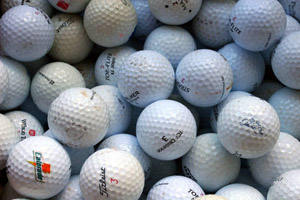
Christina MacFarlane of CNN reports that 300 million balls are lost or discarded in the United States every year! There were no numbers for world estimates, but you can bet it’s a lot because there are a lot of countries in which golf is being played. I think double the 300 million, would be a conservative estimate. The US might like to play “us versus the world” in those team golf tournaments like the Ryder Cup, but that doesn’t mean they have half the golf players, courses and balls in the world.
Furthermore, each golf ball is estimated to require 100 to 1000 years to decompose naturally. This is according to simulations done by research teams at the Danish Golf Union. It had to be simulations because the golf balls of today haven’t been around 100 years.
In case you don’t think golf ball pollution is a problem, though, scientists who scoured the depths of Scotland’s Loch Ness in a submarine recently, hoping to discover evidence of the prehistoric Loch Ness monster, found hundreds of thousands of golf balls lining the bed of the loch!
That’s hundreds of thousands of golf balls!
Maybe the golf fanatics know about golfing around Loch Ness, but I sure as heck didn’t think there was that much golfing around there. At least not so close that hundreds of thousands of golf balls would be in the lake. It’s not like everybody shoots with the range of Tiger Woods, and even then, that’s not that far to get a golf ball into the loch!
Given the pollution of that magnitude, the poor monster is probably dead from either being pelted by stray golf balls, or having swallowed some in searching for food and picking up large morsels of things at the bottom.
Unfortunately, the pollution of golf balls is not just the presence of those balls. What’s in them is very bad for the environment.
The Danish Golf Association has found that during decomposition, the golf balls dissolved to release a high quantity of heavy metals. Dangerous levels of zinc were found in the synthetic rubber filling used in solid core golf balls. When submerged in water, the zinc attached itself to the ground sediment and poisoned the surrounding flora and fauna. Then, removing a partially degraded ball from a lake or woodland area could result in further damage to the wildlife. It’s not all that simple as picking them up, though a few hundred thousand under water could be rather difficult.
So what can we do about the golf balls? Well, the easiest thing would be to stop playing golf. Golf balls are the least of golf’s environmental impact. Look at these statistics about golf courses from 2004… never mind 2009.
2.5 billion gallons – Amount of water it would take, per day, to support 4.7 billion people at the UN daily minimum, or the amount of water used, per day, to irrigate the world’s golf courses
23 – Number of golf courses in Japan before World War II
3,030 – Number in operation or soon to open in 2004
8.2 kg – Average amount of pesticides used per acre, per year, on golf courses (18.0 lbs), compared to just 2.7 kg (1.2 kg) used in the same time and space for agriculture (667% difference)
6,500 cubic metres (6.5 million litres) – Amount of water used by 60,000 villagers in Thailand, on average, per day, or one golf course in Thailand, on average, per day
150,000 acres – Current area of the wetlands of the Colorado River Delta, which now receives just 0.1 percent of the river water that once flowed through it, or the area that could be covered to a depth of 2 feet with water drawn from the Colorado River by the city of Las Vegas, which uses much of that allotment to water its more than 60 golf courses
Don’t forget all the travel, whether vacation or golf carts, involved and the emissions from it!
Really, is golf really worth all that?
Sure, the golf fanatics would say yes. But what if I were to tell you some other sport had that impact? Or every other sport out there had it since why put it on just one sport? Would you allow people to play that sport then?
But on the golf balls pollution issue, UK law maker Patrick Harvie had this advice:
“Keep your balls on the fairway or invest in a stock of biodegradable balls.”
 Christina MacFarlane of CNN reports that 300 million balls are lost or discarded in the United States every year! There were no numbers for world estimates, but you can bet it’s a lot because there are a lot of countries in which golf is being played. I think double the 300 million, would be a conservative estimate. The US might like to play “us versus the world” in those team golf tournaments like the
 Digital Citizen