The 70s song is about the struggles of a singer who moves out to California to pursue a career in Hollywood but does not have any success and deteriorates in the process. That’s in the words of Wikipedia.
Being in Halifax, Nova Scotia, sometimes known as Haliwood for its local prominence in the movie industry, I sometimes substitute “Nova Scotia” for “California”. It’s just for the cheesy fun of it.
It’s a great and catchy song that’s fairly to play otherwise. For newbies to the song, you can just skip the intro and instrumental bit in the middle. Just go through the verses. There are a few small variations among some of the lines that seem to be repeated, like It never rains in California. Pay attention to those if you want to watch the details, but most people probably wouldn’t care or notice those variations much. Otherwise, the tune is pretty close to the one in the video below.
These tabs all fit on one page to avoid the inconvenience of page turns. However, the letter size tabs (8.5″ x 11″) may be too small for your eyes. If so, you can either enlarge to tabloid size (11″ x 17″) using an automatic enlarge feature on many photocopiers, or download the tabloid sized versions for printing. The tabloid size tabs can be inserted into a typical letter sized binder on the 11″ size, and folded almost in half to fit. You just open each tab to use it.
One measure of the popularity of a song over time, and not just on the charts at a given time, is the number of covers it has. Well, there’s no shortage for Bob Dylan’s I Shall Be Released!
Bob Dylan
With every cover, there’s a little variation on it from the others and from the original. However, for this song, most only differed slightly in the notes sang and tempo. There’s no big rearrangement involved. My tabbed version is no different, with only a high D to emphasize a few important points in the lyrics. It is noted among the notes that come with the tabs.
These tabs all fit on one page to avoid the inconvenience of page turns. However, the letter size tabs (8.5″ x 11″) may be too small for your eyes. If so, you can either enlarge to tabloid size (11″ x 17″) using an automatic enlarge feature on many photocopiers, or download the tabloid sized versions for printing. The tabloid size tabs can be inserted into a typical letter sized binder on the 11″ size, and folded almost in half to fit. You just open each tab to use it.
The chord sequence is fairly easy with G, Am, Bm and back down again with Am and G. Then a D7 separates the next phrase, and it cycles all over again throughout the entire song. You need to Capo 2 this to get it in the key of A that Bob originally wrote it in. I took the chords off The Definitive Bob Dylan Songbook.
If you have trouble playing the Bm on guitar like I do, you might try the version in C, capoing as you need to get it in your voice range. That uses C, Dm, Em and G7. These are a lot easier than that Bm, in my opinion.
The ukulele challenge is also with that Bm, but I tabbed an alternate version in F because the Em (like in the guitar alternate version), is almost like that Bm on guitar, which was what I was trying to avoid. The version in F on the ukulele uses F, Gm, Am and C7, which I find all fairly easy chords to play.
As for trying to find a video close to my tabbed version, the one below from a concert in 1976 matched it best, though not exactly. This was some concert, featuring Bob and an all-star cast like Joni Mitchell, Ringo Starr and many other famous musicians! It should serve as a good guide to figuring out the tabs.
The good thing about a “solid” song like this, though, is that the chords are pretty robust to any little variation you might want to put in the melody to “make it your own”. So you don’t have to follow the notes I have. Just sing it the way it feels to you for notes and it will work.
Rhythm is another story, though! The trickiest part to this song is adjusting from phrase to phrase of when you start in. For some phrases, you strum the opening chord (like G) on the first word. For many phrases, you start in while still on the 7th chord that separates the phrases. Then for the rest, you actually strum that opening chord before you start singing, like with the opening line to the chorus. Figuring out the adjustments from line to line is the hardest part, by far, as far as I’m concerned, to learning this song.
But it just wouldn’t be Bob if it were otherwise! 🙂
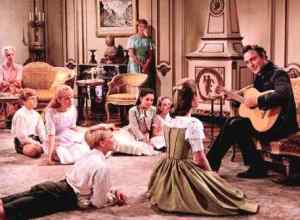
Edelweiss is a nice little song from the musical The Sound of Music. Too bad it’s a little harder to play, especially on the ukulele compared to the guitar, with a bunch of jumbled fingered chords.
What I have done is found a couple of keys in which the chords needed would be relatively easy to play, rather than trying to find the key in which it was sung in the musical. There are a billion interpretations in all kinds of keys, anyway.
The other thing I have done is to just have a repeat of all the lyrics, as if you sung it twice, with a couple of bars of humming in between. In the original, the kids came in skipping the first two lines on the repeat. I didn’t like that so I threw it out. This wasn’t about duplicating the musical exactly. Who’s got a Julie Andrews to spare?
Finally, on the last line, second time around, instead of ending with “forever”, I ended with “forever more”. It seemed to me I once heard a version sung like that and liked it so I’ve kept it in my arrangement.
Of all the versions out there, I found this one in the video below to match well to the tabs I’ve created.
Vodpod videos no longer available.
By match, I mean arrangement of verses, transitions, and so on, not key the piece is sung in necessarily. In my tabs, I have the notes written out so you can pic them to help you figure out what you need to be singing.
These tabs all fit on one page to avoid the inconvenience of page turns. However, the letter size tabs (8.5″ x 11″) may be too small for your eyes. If so, you can either enlarge to tabloid size (11″ x 17″) using an automatic enlarge feature on many photocopiers, or download the tabloid sized versions for printing. The tabloid size tabs can be inserted into a typical letter sized binder on the 11″ size, and folded almost in half to fit. You just open each tab to use it.
If the versions in the keys of D or G suit your voice range, you can pick one and put a capo to make it fit. The fact you have access to the song in two keys means you shouldn’t have to capo up any more than 5 frets to find a version that suits your range.
In the near future, I’m hoping to tab Do-Re-Mi, also from The Sound of Music and combine it to flow into this song. That’s because in Do-Re-Mi, it ends with telling the audience how you could use the notes out of order to sing any song. Edelweiss will be the example, and a good choice in being from the same musical.
In the meanwhile, I hope you’ll enjoy Edelweiss on its own. It’s a great little song, but especially for ukulele groups to learn and sing along!
This is a song that’s definitely harder to learn to sing than to play, mostly because of the high vocal range required at the end. I found a very nice fan video for it, with the original recording to which I created my guitar and ukulele tabs.
These tabs all fit on one page to avoid the inconvenience of page turns. However, the letter size tabs (8.5″ x 11″) may be too small for your eyes. If so, you can either enlarge to tabloid size (11″ x 17″) using an automatic enlarge feature on many photocopiers, or download the tabloid sized versions for printing. The tabloid size tabs can be inserted into a typical letter sized binder on the 11″ size, and folded almost in half to fit. You just open each tab to use it.
Vodpod videos no longer available.
U2
I’ve tried to put a strumming filler between verses like in the song with the main chords and slight modifications of them. You strum to the rhythm of the phrase, one stroke for each note and resting when there is a rest. It would only take you a few minutes to figure it out and once you do, it wouldn’t be very hard to play because I’m not trying to show off any skills here. I’m just trying to avoid gaping holes in the song played by one person and one instrument when there doesn’t need to be such a gap.
The capitalized letter of the song notes are meant to be an octave higher than the notes with non-capitalized letters. The ending, as you can hear on the song, is very high. Most guys will have to use falsetto to sing this, but give it a go.
At last count, there’s over 125 official cover versions of You Raise Me Up. This song was basically new lyrics written for the old Danny Boy tune. That was, in turn, ripped off from the lyric lacking Irish anthem, Londonderry Air. However, Londonderry Air has had many other incarnations with other sets of lyrics, some of which, I must say, are pretty epicly elaborate.
You interpret what all that means in whatever way you like, but this is a very beautiful and uplifting song.
I’ve chosen to tab the version of You Raise Me Up by Josh Groban because I knew it best and was introduced to the song by his cover.
Vodpod videos no longer available.
Josh Groban
I’ve replaced the intro violin with just a hum and strum of a verse. The rest should be fairly simple to follow. I’ve included notes of the tune because there are some crazy interval jumps in there. That’s about the only challenging part to the song. The strum should be a very slow strum to suit the speed of the song.
These tabs all fit on one page to avoid the inconvenience of page turns. However, the letter size tabs (8.5″ x 11″) may be too small for your eyes. If so, you can either enlarge to tabloid size (11″ x 17″) using an automatic enlarge feature on many photocopiers, or download the tabloid sized versions for printing. The tabloid size tabs can be inserted into a typical letter sized binder on the 11″ size, and folded almost in half to fit. You just open each tab to use it.
If you’re going to play this on a traditional soprano, concert or tenor ukulele with a high G string as the first string, you’re going to have to “dig deep” to find your first note because it is an octave below that. That’s if you don’t capo it to get it in the same key as it should be, but that’s not necessary. You might want to capo it quite a few notches if you don’t sing so low, even if you sing it all an octave higher.
I hope you enjoy the tabs because it is a gorgeous song, indeed!


 By match, I mean arrangement of verses, transitions, and so on, not key the piece is sung in necessarily. In my tabs, I have the notes written out so you can pic them to help you figure out what you need to be singing.


 Digital Citizen