What’s Your Song of Friendship? (Part 1 of 7 on the World in Six Songs)

Share/Save/Bookmark
.

Book and Theory Background

Daniel J. Levitin wrote an absolutely brilliant book called The World in Six Songs, supported by a great website with the many music samples referenced, among other great related material.

My basic paraphrasing of the concept is this. All the songs in the world could be fit into at least one of six categories providing an evolutionary benefit to humanity, often ultimately tied to our social nature.

The book and website offer far more detailed interpretations, of course, but I will expand on my paraphrasing with each post and the associated topic.
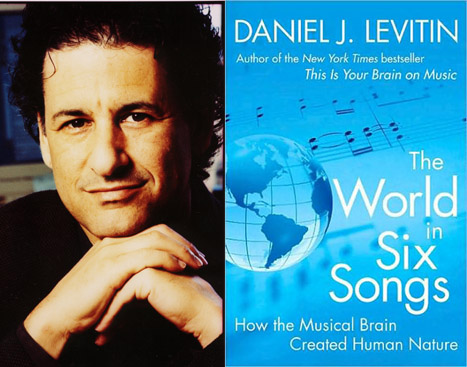
Daniel J. Levitin and The World in Six SongsIn a series of posts, I will describe each of the six categories in brief, one at a time:

  1. Friendship
  2. Joy
  3. Comfort
  4. Knowledge
  5. Religion
  6. Love

I will describe what the categories are about because they are not as limited in scope as the category names suggest. I will then supply one of my choices and ask all readers to do the same if they so wish. In the seventh post of the series, I will offer the chance to put the song choices all together so readers can read the entire set on one post. I do this because it would be a long post to describe all six categories at once, but to have all the answers in one place might be nice.

.

This post focuses on Songs of Friendship

July 30th add-on in italics, from Dan Levitin in a summary article
Friendship songs centre around group cohesion, whether it be for war, or the bonding of different cliques in high school. For example, in prehistoric warfare, attackers would sometimes ambush another tribe using loud instruments (especially drums) to surprise the targets while they were still sleeping. Countertactics employing the use of singing may also have been used as a signal that the group was awake.  These songs serve to protect a tribe/group or succeed in the takeover of another. In the context of social groups, they provide a sense of community and belonging, bringing people together.

These songs serve the purpose of bringing people together to promote cooperation in one form or another in order to survive, or at least make life more tolerable. Applied to various situations, cooperation could promote any of these situations:

  • Working together
  • Attacking/defending together
  • Supporting each other
  • Friendship
  • Averting conflict
  • Forging group identity (maybe not formally but like a bonding anthem for a group of “outcasts”)
  • Others

The evolutionary value is that humans interact socially, whether in friendly or destructive ways. If we can avoid the latter, like in wars, we are more likely to survive and thrive as a species. Our social bonds are essential to our well-being, and we do survive and thrive better in groups, so anything that helps us in these causes are beneficial to our evolution as a species.

Audio sample of songs from the Friendship chapter in The World in Six Songs can be found on the website. No direct link was available, but click on the Songs menu option and appropriate page number range link carrying pages 41 to 82. Please note that not all songs are meant as samples of Friendship songs. Some are just referenced material in the book text.

.

Author Daniel Levitin chose

.

My choice for Song of Friendship is

You’ve Got a Friend by Carole King (lyrics).

It fits into the Friendship subcategory of various bonding purposes, but I do believe that true friends ultimately help each other. There isn’t any other song I know and feel tells someone they’ve got a true friend better than this Carole King song. Nobody sings it better, either!

.

What is your choice for Song of Friendship?

Please leave your choice as a comment.

Lyrics and YouTube/audio link would greatly enhance your answer so readers can know more about your choice. They are not necessary, though, and not possible if no lyrics or version exist.

You can include songs you wrote as a choice, too!

Flesch-Kincaid Grade Reading Level: 10.5
An Étude in Noteflight.com

Noteflight.com is a music composition webware. It allows you to compose sheet music online in their website, play it and share it as a follow the music style video. Copying and pasting code is about as complicated as it gets for social bookmark style sharing, but the entire package is brilliant. This despite a few shortcomings still present in Beta 3 version.

Isn’t the free world wide web great these days? Everything is going on-line via webware, and “software is so passé” according to CNET and I can’t say I disagree. Their blog has like 10 entries a day on webware for crying out loud! Soon, we’ll only need to get the same scripts on our electronic devices (far more than just computers) and the browser will serve as the means for everything. We will only need the scripts on our electronic devices for when we don’t have a reliable connection and might lose data.

The latest webware I happened upon is sheet music composition software at Noteflight.com. I learned about it from Wesley Fok in his awesome weekly columns called Apps We Love in the Globe & Mail (Canadian paper). Being a bit of an amateur musician, who happened to have composed something like 15 years ago, I not only got to try the site, but I had personal vested interest.

I found the site to be fairly good, though not yet at the quality of expensive software like Finale. You can still do quite a lot with this software. I’m sure there are many things people wish it had, and it will with progressive versions, but this is great for now. The only thing I found on this first go that was disappointing was I could not change tempo in the middle of a piece. They’ll get that sorted out soon enough as it’s just timing and is a digital fix.

But more than just music composition, you can share the file and have multiple people work on it. Then you can share it on blogs and such. They give you some codes and you just throw it in somewhere. It doesn’t quite work for every platform yet. I can’t embed it in my WordPress.com post, for example. However, I can collect it with my VodPod account and widget to the right. I just put those codes from Noteflight.com into the collector, it gives me a page to view it, and I can link the URL to the text like here.

The computer “performance” is less than stellar without the ability for me to indicate tempo changes that were all over this piece. It loses a lot of its life without the appropriate tempo changes. However, I’ll take it just to be able to share it. When the better beta versions come out, I will update it.

As for my étude, it was something I composed to get around stupid and horrible sounding exercises. I was teaching myself piano, cowboy style, you see. Jump in and shoot. Ask questions later. I had no piano training, but I was teaching myself to play the first movement of Beethoven’s Moonlight Sonata (video below) because there were many nights I needed to play it for therapy in the moonlight coming through my bedroom window.

Wow! That video link has over 6.5 million views!!! Talk about timeless! Beethoven gone majorly viral!

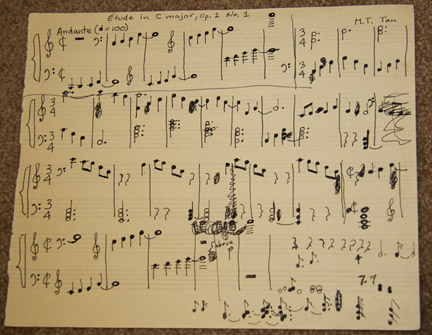
Etude in C, Op. 1 No. 1, by Minh Tan (original manuscript)

Etude in C, Op. 1 No. 1, by Minh Tan (original manuscript)

Anyway, there were some things about piano playing in that Sonata I was really being challenged by so to get around it, I composed aptly named étude style pieces. I only ever got around to completing one, but I have held on to it like a Beethoven original manuscript. Lo and behold, 15 years later, serendipity, synchronicity and karma had given it a better purpose and meaning in my life. I had it to try and share with the world. It did get a public viewing I never allowed it after all! Life really kicks you know what when you can have skeletons of this sort in your closet!

It’s instances like this, actually, which have happened frequently in my short life thus far that led me to write my six-word memoir as being

Everything done will mean more later

.

Flesch-Kincaid Grade Reading Level: 7.0

Share/Save/Bookmark